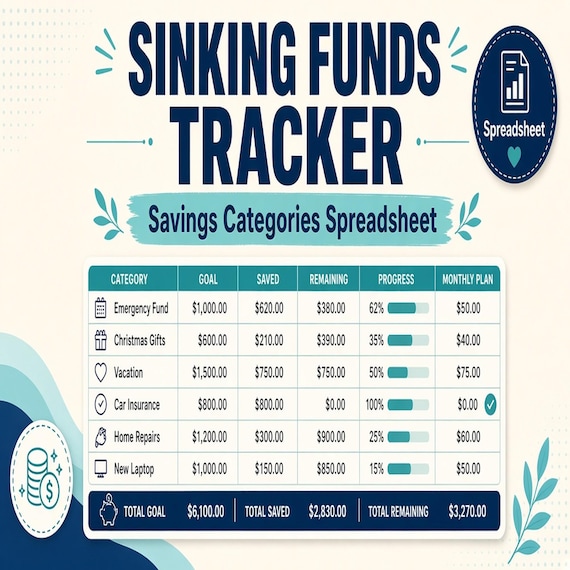
Sinking Funds Tracker Spreadsheet
Plan irregular expenses before they hit with a sinking funds tracker, cash-envelope style savings planner and…
$15.97Etsy
Free tool
List the costs you know are coming, what you've already saved and the date you need each one. The calculator tells you how much to set aside every paycheck and every month so each fund is ready on time. Add as many funds as you like.
Add it to count your real pay dates. Left blank, paychecks are estimated.
Payday on the due date? It counts only if that pay is available before the bill is due. If it isn’t, enter the day before as the date.
Each fund is split evenly over the paychecks left before its date. The monthly figure spreads the same amount over the time actually left (days left ÷ 30.44, the average month); funds due in under a month show a per-paycheck amount and a total instead of a monthly rate. With a next payday, the calculator lists your real pay dates and counts only paydays on or before each date. A payday on the date counts only if that pay is available before the bill is due. Without one, it estimates whole paychecks from the days left. Nothing you type leaves your browser.
Instant downloads from the SteadyStackStudio Etsy shop.
Plan irregular expenses before they hit with a sinking funds tracker, cash-envelope style savings planner and…
Save a little each month for the big costs you know are coming, so they never catch you off guard.
See what the holidays really cost, then start 2027 with a clean, simple plan. Christmas Spending Recap, planned vs spent for 10 categories No Spend January 2027 calendar, dated Monthly Budget with 14 categories Expense L
Plan your whole money year in one binder. This 2027 Budget Binder has a calendar and a budget page for every month, plus trackers…
A sinking fund is money you set aside a little at a time for a cost you know is coming, like holiday gifts, car insurance or school supplies, so it does not land on one paycheck.
For each fund it takes the goal minus what you have saved, then divides it evenly by the paychecks left before the date you need it, rounded to the cent. The monthly figure spreads the same amount over the time actually left (days left ÷ 30.44, the average month length), so a fund due in seven weeks is spread over about 1.7 months. If the date is less than a month away, it shows the per-paycheck amount and the total instead of a monthly rate. The totals add up every fund.
Add your next payday and the calculator lists your real pay dates: every 7 days for weekly pay, every 14 days for every two weeks, the 15th and the last day of the month for twice a month, and the same day each month for monthly (moved to the last day in shorter months). Only paydays on or before the date you need the money are counted. A payday on that date counts only if that pay is available before the bill is due. If no scheduled payday falls before the date, it tells you the remaining amount isn’t covered by the plan, so you can review the target date, the amount or the money you have available. Leave next payday blank and it estimates whole paychecks instead (52, 26 or 24 a year spread over the days left).
Only the paydays on or before the deadline count. For example, paid every two weeks with a next payday of Oct 23, 2026 and a deadline of Dec 12, the paydays counted are Oct 23, Nov 6, Nov 20 and Dec 4. The Dec 18 payday comes too late, so a $600 goal with $100 saved works out to $125 per paycheck.
Only if that pay is available before the bill is due. The calculator counts a payday that falls on the date. If the money won’t be in your account in time to pay the bill, enter the day before as the date so that payday isn’t counted.
The fund is flagged with the amount still to go. Pick a new date to get a fresh plan.
No. Everything runs in your browser and nothing is stored or sent.
Free to share on a blog, resource page, class site or newsletter. Copy the link code below, or use the citation.