Therapy Worksheets · Sep 17, 2026 · 19 min read
Motivational Interviewing Worksheet Setup: Plan OARS, Catch Change Talk, and Keep One Next Action
A practical setup for the motivational interviewing toolkit: confirm the 18-page PDF and matching Word files, choose one conversation goal, use OARS pages as a planning aid, record change talk in the client’s language, check values and confidence, then keep one next action visible without rushing a plan.
Confirm what the current download includes
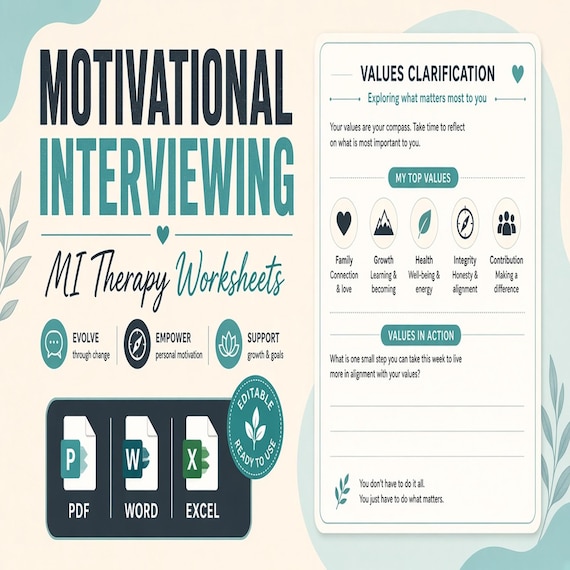
Start with the files the current listing actually describes. The SteadyStackStudio Motivational Interviewing Worksheets pack is a digital toolkit for counselors, social workers, coaches, supervised trainees, and other trained helping professionals who already use motivational interviewing principles. The listed contents are an 18-page printable workbook, an editable Word version of every worksheet, OARS planning pages and reflection prompts, change-talk, values, confidence, and action-planning tools, plus a start-here guide and plain-language usage notes. It is an instant digital download in a ZIP. No printed binder, laminated card set, or training certificate ships.
Open the unzipped folder and compare it with that list before anyone writes a real name on a page. Confirm you received the US Letter PDF for printing or digital annotation and the matching Word files for customizing headings and fields. The listing also mentions an organized Excel workbook where noted. If that file is in the ZIP, treat it as an optional organizer for the pages the listing flags, not as an electronic health record, scoring engine, or session timer. If a start-here guide or usage note is in the folder, read it before you duplicate pages for a second client, a group, or a supervisee.
The listing is explicit about scope. These pages are an educational and organizational resource. They are not a diagnosis, a treatment protocol, a crisis tool, an EHR, or a substitute for training, supervision, informed consent, or professional judgment. You remain responsible for matching every page to the conversation in front of you and to the record rules that apply in your setting. Do not enter identifying health information into systems your organization has not approved. Personal or single-practice use for the purchasing buyer is the usual digital-download rule. Do not resell, share, or redistribute the raw template files.
- Verify the ZIP against the listed 18-page workbook, matching Word files, OARS planning pages, change-talk, values, confidence, and action-planning tools, and the start-here guide.
- Confirm US Letter PDF plus editable Word. Treat any Excel file only where the listing notes one.
- Read the start-here guide and usage notes before a second person edits a working copy.
- Treat the pack as conversation paperwork, not as a diagnosis, crisis protocol, or approved clinical system.
Decide whether an MI conversation pack is the missing job
This pack fits when the friction is the conversation about change, not the rest of the chart. A case-formulation toolkit can hold a working hypothesis across the four Ps. A progress-notes kit can hold SOAP, DAP, or BIRP pages and a treatment-plan review. A supervision pack can hold agendas, feedback, and hour records. An SFBT toolkit can hold a preferred future, exceptions, and a scale. An ACT workbook can hold values, defusion, and committed action. Those jobs matter. None of them is the same as preparing OARS, noticing change talk, checking values and confidence, and leaving one next action visible.
It also fits when you already know the MI style and still lose the thread between sessions. Practitioners often keep open questions in a notebook, a values comment in a progress note, and the “one small step” in a text the client sent later. That works until the next hour starts with a different story and the last agreement is gone. A short OARS planning page plus a change-talk record plus a confidence check is a better match for that job than a thought record that debates a cognition, or a miracle-question page that asks for a preferred future the client has not asked to describe.
Skip this pack, or use it only as a neighbor, if the real need is a formulation, a required note format, a supervision hours log, a preferred-future worksheet, or an ACT defusion exercise. Those jobs live in their own downloads. Skip it if you wanted a self-help journal for someone who is not working with a trained professional. The listing is written for counselors, social workers, coaches, supervised trainees, and other trained helping professionals. Skip it if you needed a crisis protocol, a risk instrument, or software that files notes into an EHR. Choose the smallest complete download that matches the missing job.
- Use this pack when OARS planning, change-talk notes, values, confidence, and one next action are the gap.
- Use it when a conversation about ambivalence needs a page, not when the chart needs a required note format.
- Do not expect a diagnosis tool, a crisis protocol, or an approved record system.
- Do not buy it first if the real need is SFBT scaling, ACT defusion, a 4 Ps formulation, or SOAP notes.
Protect the master and make a working copy
Download the ZIP once, unzip it into a folder you will not edit, and duplicate that folder for practice and for any later permitted use. Name the master something obvious, such as original-motivational-interviewing-toolkit, and leave it closed. All heading edits, sample language, and printer tests happen in the working copy. If a Word field is overwritten or a PDF print is cropped, you still have the listed files for the next conversation.
Keep the formats in their roles. Use the PDF when you want a stable print or a tablet annotation that should not drift. Use Word when a heading, prompt, or field label needs to match the language your setting already uses. If an Excel workbook is present where the listing notes one, use it only as a light organizer, not as a place to store identifying health information. Do not invent a fourth unofficial version in a notes app that uses different prompts than the page you handed the client.
Write a one-line use note in the working folder: this setting, this conversation goal, this date, this file format. That note stops last month’s sample page from being treated as a live record. Finished professional use is not the same as redistributing the raw pack. If a supervisee will practice with the files, keep one live working copy, a short rule about fictional versus real information, and the start-here guide at the front of the folder.
- Unzip once, keep a locked master, and edit only a duplicate.
- Use PDF for a stable print, Word for heading and field edits, and any noted Excel file only as an organizer.
- Write the setting, conversation goal, and date on the working folder so a sample page is not reused as a live record.
- Follow the listed license: practice use is not the same as sending the raw ZIP to someone who did not purchase it.
Read the start-here guide and name one conversation goal
The listing’s own how-to is short on purpose. Choose the worksheet that matches the conversation goal. Print it or edit the Word version for your setting. Use professional judgment and the client’s own language. Keep only the records your policy and local rules allow. That order is the whole setup. The 18-page workbook is not a packet that must be finished from page one to page eighteen in a single hour.
Name the immediate job in one sentence before you pick a page. Typical MI jobs are: prepare open questions and reflections for this hour, notice and write change talk without arguing, clarify what matters enough to make a change feel important, check whether confidence can carry a small step, or write one next action the client actually said. If you cannot name the job, do not open three pages “just in case.” A stack of unused worksheets becomes another demand the client has to manage.
Match the page to the process of the conversation, not to a wish for faster change. Early work is often engaging and focusing: Can we talk together, and what are we even talking about? Evoking work asks for the client’s own reasons. Planning work comes later, when there is enough change talk and enough confidence to make a next action honest. If you start on an action-planning tool because the clock is short, the page will ask for a plan the conversation has not earned. Put the unused pages back in the folder.
- Read the start-here guide first, then choose one page for one conversation goal.
- Write the goal in one sentence before you print or customize Word.
- Do not run the 18-page workbook as a single-session packet.
- Leave action-planning tools closed until the conversation has change talk and enough confidence to make a step real.
Use OARS pages as a planning aid, not a script
OARS planning pages and reflection prompts are there so you can prepare, not so you can read a script across the table. Open questions, affirmations, reflective listening, and summaries are skills you already bring if this pack is a fit. The page’s job is to hold a few questions you might ask, a strength you already heard, a reflection you do not want to lose, and a summary you can offer back. If the page starts to sound like an interview protocol, you have overfilled it.
Prepare in the client’s likely language, then leave room to abandon the plan. A useful OARS page for a drinking conversation is not a list of ten clever questions. It is two or three open questions that invite the person’s own reasons, a blank for an affirmation that has to be true, and space for a reflection that does not add advice. If the client talks about sleep, family, or work instead of the topic you prepared, follow that. The unused question can stay unused. The worksheet is not a fidelity checklist you complete for its own sake.
Keep partnership visible on the page. Motivational interviewing is a collaborative style for talking about ambivalence. The helper does not win the argument. If your OARS notes start to look like a case for why the client should change, rewrite them before the session. Affirmations name what is already true and specific. Reflections guess at meaning and check it. Summaries collect, they do not close the case. When a prompt on the page would push, skip it. Professional judgment includes leaving a field blank.
- Fill OARS pages with a few questions, one true affirmation space, and room for reflections and a summary.
- Prepare, then follow the conversation; unused prompts are allowed.
- Rewrite any notes that argue for change instead of inviting the client’s own reasons.
- Do not treat the OARS page as a scored fidelity form or a script you must finish.
Record change talk in the client’s own language
Change-talk tools in this pack are for catching what the person already said, not for manufacturing motivation. Desire, ability, reasons, and need often show up as ordinary sentences: I want mornings to feel different. I could skip the second drink. If I keep this up, I will miss the kids’ games. I have to do something about the bloodwork. Commitment, activation, and taking a step sound stronger: I will, I am ready to, I already did. Write the words you heard. Do not upgrade “I might” into “I will” because the form has a nicer box.
Separate change talk from sustain talk without shaming either one. Ambivalence is normal. A page that only stores the “good” lines will teach the client to perform. A more honest record might note both “I am tired of this” and “Fridays are the only time I relax,” then leave the tension on the page instead of resolving it for them. Your job on the worksheet is to notice, not to cross-examine. If you find yourself listing counter-arguments, you have left MI and started a debate.
Use the client’s words in any summary you read back. If they said “cut back on weeknights,” do not write “abstinence plan.” If they said “talk to my sister,” do not write “increase social support.” The later action page will be more honest if the change-talk page stayed close to the sentence you heard. If your setting does not allow you to keep a worksheet with quoted language, use the page as a session aid and transfer only what the record policy permits, then destroy or store the working page according to that policy.
- Write change talk as heard. Do not upgrade a maybe into a commitment.
- Leave room for sustain talk so the page does not become a performance.
- Keep quoted language close to the client’s sentence, not a clinical rewrite.
- Follow record policy for what may be kept, transferred, or destroyed after the hour.
Check values and confidence before opening an action page
The listing includes values tools and confidence tools for a reason. A next action that ignores both will look complete on paper and collapse by Thursday. Values pages in this pack are for hearing what already matters to this person, in their words, so a possible change can be held next to something they care about. They are not a life-purpose curriculum and they are not the same job as an ACT values-and-defusion workbook. If the missing work is noticing thoughts and choosing a valued action with willingness, compare the ACT guide instead of stretching this MI pack.
Ask whether the change is important enough, and whether the person believes a step is possible, before you hand over an action-planning tool. Confidence that is low is information, not noncompliance. A confidence page can hold what would make a smaller step feel doable, who already helps, and what has worked for even a day. It should not become a pep talk you write on their behalf. If importance is high and confidence is low, stay with evoking and smaller experiments. If both are low, you may still be in engaging or focusing. The action page can wait.
Watch for helper urgency. End-of-session pressure is how premature plans get written. A values line such as “I want to be present with my kids” plus a confidence of “I freeze when my friends pour a drink” is not a failure of the worksheet. It is a signal to keep the conversation there, maybe with one OARS reflection, instead of filling an action grid because the hour is ending. The start-here guide’s instruction to choose the worksheet that matches the conversation goal includes choosing not to use the action page today.
- Use values tools to hear what already matters, in the client’s language, not to assign a purpose statement.
- Check confidence before planning. Low confidence means a smaller step or no plan yet, not a lecture.
- Do not substitute this pack for an ACT values, defusion, and committed-action workbook.
- If the hour is ending and the conversation is still ambivalent, leave the action-planning tool closed.
Keep one next action visible, and postpone planning if the conversation is not there yet
When planning is actually the job, the action-planning tools should hold one next action the client can picture, not a twelve-week overhaul. A useful line names what, when, where, and how they will know it happened, in language they would text to a friend. “I will not drink this month” is often too large. “I will take the smaller glass on Friday and leave at ten” is a step you can review. If the page invites more than one action, still circle one as the action you will ask about next time.
Postpone planning when the conversation is still exploring. A common failure is to close with a plan because helpers are trained to leave with a task. Motivational interviewing treats planning as a process that follows enough evoking, not as a required ending. If change talk is thin, if the person is arguing with your summary, or if confidence is a shrug, write “no plan today” on your working notes and name the next conversation goal instead. That is a complete use of the toolkit.
Review the action later without turning the page into a scorecard. Ask what happened, what got in the way, and what the person wants to keep, change, or drop. If they did something different from the written step and it helped, update the page to the real action. If they did not do it, treat that as information about fit, confidence, or importance, not as proof they were unmotivated. Keep the reviewed page with the same privacy rules as the rest of the working copy.
- Write one next action the client can picture, in their words, with a way to notice it happened.
- If the page allows several steps, still mark one as the action you will ask about next time.
- It is a valid outcome to write that there is no plan today.
- Review what actually happened without scoring the person or inflating the original commitment.
Match PDF, Word, and any noted Excel file to an approved record workflow
Choose the file format for the job your setting allows, not for the format that looks busiest. The US Letter PDF is the right first choice when you need a print, a clipboard page, or tablet annotation that should stay visually stable. Word is the right first choice when you must change a heading, add your practice name in a permitted way, or remove a prompt that does not fit this conversation. Do not edit Word into a different clinical instrument and then treat the listing’s disclaimer as if it no longer applies.
If an Excel workbook is included where noted, decide its job before you type a name. A spreadsheet can help you see which page you used and when you last reviewed an action. It cannot become a shadow chart. Do not put diagnoses, risk details, or identifiers into a personal drive, a shared inbox, or an unapproved cloud folder. If you are not sure whether a working file is allowed, pause and confirm with the employer, supervisor, privacy lead, or other qualified authority before a real conversation lands on the page.
Keep worksheet notes separate from required records unless policy says the page is the record. Many settings need a progress note in an approved system and treat a conversation worksheet as a session aid. In that case, transfer only the minimum necessary information, in the required format, and handle the paper or Word copy according to retention and destruction rules. The listing’s warning not to enter identifying health information into unapproved systems is a setup step, not fine print to read after a breach. Sample or fully fictional information is what you use for printer and layout tests.
- Pick PDF for a stable print or annotation, Word for permitted heading and field edits.
- Use any noted Excel file only as a light organizer, never as a shadow chart.
- Confirm storage, access, printing, and destruction rules before real information goes on a page.
- Do not assume a worksheet is the official record unless your setting says it is.
Run a fictional conversation test before real notes
A short test will show more than a cover image. Open the files on the printer and device you will actually use. Fill one OARS planning page, one change-talk record, and either a values or confidence page with a fully fictional adult and a non-crisis topic such as changing a commute or cutting back on late-night scrolling. Then decide whether an action-planning tool is earned. If it is not, practice writing that there is no plan today. If it is, write one small next action in the fictional person’s words.
Check the handoff. Could you, a week later, tell the difference between what the person said and what you hoped they would say? Could a supervisor, if policy allows, see the conversation goal, the change talk, the confidence note, and the single next action without guessing? If the page only makes sense because you remember the hour, the notes are too thin or too rewritten. If the page reads like a lecture, you overfilled it. Adjust the working copy, not the master.
Test print and Word edits on the same paper you will use in the room. US Letter is the listed size. Confirm margins, staple or clipboard fit, and whether a client-facing page still looks calm after your heading edits. Confirm that a tablet annotation, if you use one, does not auto-sync into an unapproved account. If the files will not open, print, or stay readable, stop. Do not invent a workaround that the listing does not describe, and do not put a real conversation on a broken layout.
- Practice with a fully fictional, non-crisis conversation before any real name is written.
- Complete one OARS page, one change-talk page, and a values or confidence page; add an action page only if it is earned.
- Check that a later reader can tell the client’s words from the helper’s hopes.
- Test US Letter printing, Word edits, and any tablet annotation against your approved devices.
Compare neighboring downloads so you do not buy the wrong job
The motivational interviewing toolkit sits beside other counseling downloads that look similar in a thumbnail and do different work in the hour. Choose this pack when the missing job is OARS planning, change-talk notes, values and confidence, and one next action. Choose the SFBT toolkit when the conversation is a preferred future, exceptions, scaling, and a workable next step in that style. Both can end with a small action. They do not start from the same questions, and this guide is not a substitute for the SFBT setup.
Choose the ACT workbook when values need to sit with defusion, willingness, and committed action as a process, not only as a reason for change. Choose the 4 Ps case-formulation toolkit when you need a revisable working hypothesis across assessment details, context, maintaining patterns, and review. Choose the progress-notes and treatment-planner product when SOAP, DAP, BIRP, intake, or a treatment-plan page is the required document. Choose the clinical-supervision pack when the job is case preparation, feedback, action items, and hour records. Choose the therapy termination pack when the work is ending care, reviewing goals, and writing a maintenance plan.
You do not need every neighboring file for one client. A formulation can explain why an MI conversation is being offered. A progress note can record that the conversation happened. A supervision page can review how you used OARS. Those are different pieces of paper with different retention rules. Buy the smallest complete download that matches the gap you still have after those other jobs are named. If you only needed a required note template, this MI pack will sit unused while the chart still has no SOAP page.
- MI pack: OARS, change talk, values, confidence, one next action.
- SFBT pack: preferred future, exceptions, scaling, and a next step in that style.
- ACT pack: values with defusion, willingness, and committed action.
- Formulation, progress notes, supervision, and termination packs each cover a different documentation or transition job.
Who this fits, who should skip it, and what to check before Etsy
This kit fits a trained counselor, social worker, coach, supervised trainee, or other helping professional who already uses motivational interviewing principles and needs pages for preparing OARS, recording change talk, checking values and confidence, and keeping one next action visible. It fits when ambivalence is the current work and a worksheet should support the conversation rather than replace it. It can support many change topics the practitioner is already qualified to discuss. It does not decide those topics for you, and it does not make an unqualified helper into a clinician.
Skip it if you only needed SFBT scaling, ACT defusion, a 4 Ps formulation, SOAP notes, supervision hours, or a termination packet. Skip it if you wanted a self-help journal, a crisis plan, a diagnostic instrument, or software that files into an EHR. Skip it if nobody will read the start-here guide or choose one page at a time. Skip it if your setting forbids printable or Word worksheets for this kind of conversation. The listing does not describe those other tools, and this page does not add them.
Before you open Etsy, look at the current product page. Confirm the listed files: 18-page printable workbook, editable Word version of every worksheet, OARS planning pages and reflection prompts, change-talk, values, confidence, and action-planning tools, start-here guide and usage notes, US Letter PDF, ZIP download, no physical item. Confirm the educational and organizational scope, the instruction to use professional judgment and the client’s own language, and the warning not to enter identifying health information into unapproved systems. Confirm that remaining listing previews are page renders from the files, and that the first styled cover image was created with AI. If those facts match the job you still have after formulation, notes, SFBT, and ACT are ruled in or out, the download has a defined use. If you cannot name the conversation goal and the first page you would choose, keep comparing rather than buying a large counseling folder in the hope that a style will appear later.
- Good fit: a trained professional or supervised trainee who needs OARS, change-talk, values, confidence, and one next-action pages.
- Confirm: current previews, 18-page PDF plus matching Word, start-here guide, digital ZIP only, and the educational-resource scope note.
- Pause: you need SFBT, ACT, a formulation, required progress notes, supervision hours, a crisis tool, or an EHR.
- Proceed only when you can name the conversation goal and the first page you will use.
Printables used in this guide
Instant downloads from the SteadyStackStudio Etsy shop.
Motivational Interviewing Worksheets
A calm, practical download for counselors, social workers, coaches, supervised trainees, and other trained helping professionals…
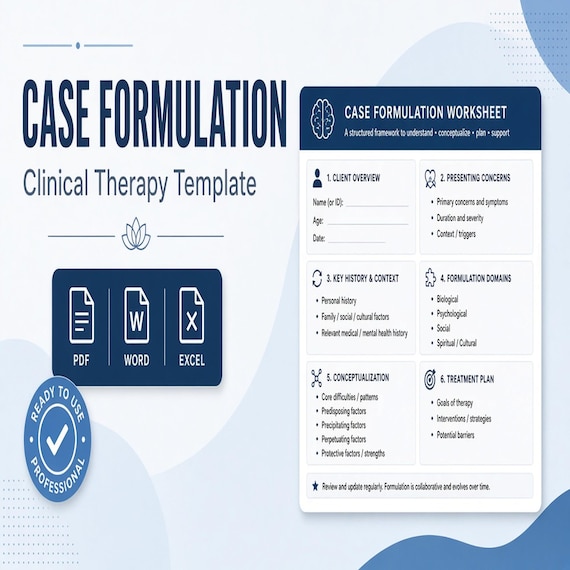
Case Formulation Template
Therapist Case Formulation & Conceptualization Toolkit Bring assessment details, working hypotheses, strengths, context…
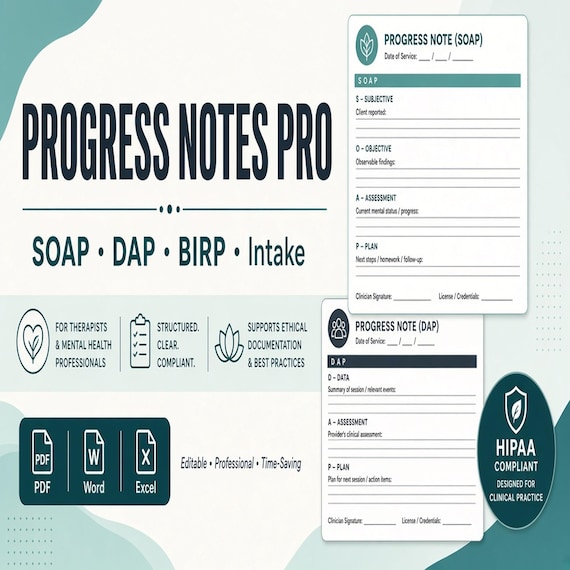
SOAP Note Template and Therapy Progress Notes
Therapist Progress Notes Pro — a mid-tier multi-format documentation pack for clinicians who want real SOAP, DAP, and BIRP…
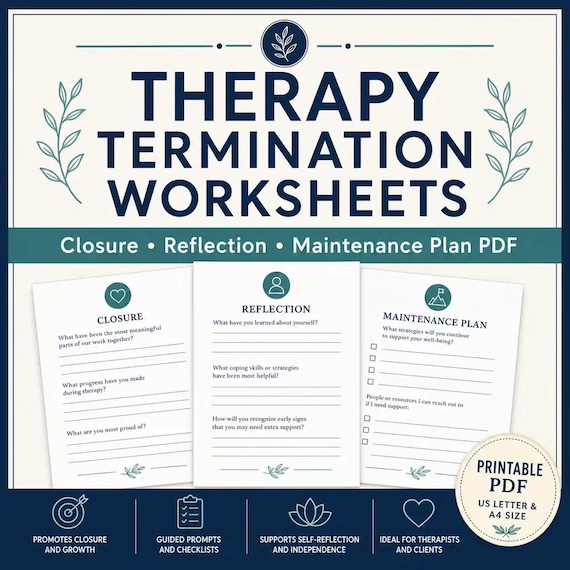
Therapy Termination Worksheets
A calm, practical download for trained therapists, counselors, social workers, and supervised trainees planning a thoughtful…