Therapy Worksheets · Aug 25, 2026 · 13 min read
CBT Thought Record Setup: Choose a Quick Page, Test Evidence, and Write a Balanced Thought
A practical setup guide for choosing a quick or full CBT thought record, separating observations from interpretations, testing evidence, and writing a balanced response without printing an entire workbook.
Start with one record, not the entire workbook
A thought-record workbook is easier to use when one page has one clear job. Do not begin by printing every worksheet or trying to examine every thought from the week. Choose one recent, specific moment that is safe and manageable enough to review. The goal is to slow that moment down, notice what happened, and leave with a more useful response—not to finish a large packet in one sitting.
Use an example with a beginning and an end: a message arrived, a meeting changed, a plan fell through, or a conversation felt awkward. A broad statement such as “everything is going badly” is difficult to test because it contains many events at once. A narrow example gives the prompts something concrete to hold and makes it easier to decide whether a quick record is enough or a fuller page would help.
If the situation involves immediate danger, severe distress, abuse, a crisis, or material that does not feel safe to approach alone, pause the worksheet. A printable can support reflection and preparation, but it is not crisis care, diagnosis, or a replacement for qualified professional support.
- Choose one recent event rather than a whole week or relationship.
- Pick an example you can describe in a few factual sentences.
- Decide whether the page is for private reflection, guided work, or later discussion.
- Stop and seek appropriate support when a self-guided page is not a safe fit.
Confirm the current PDF package fits your working style
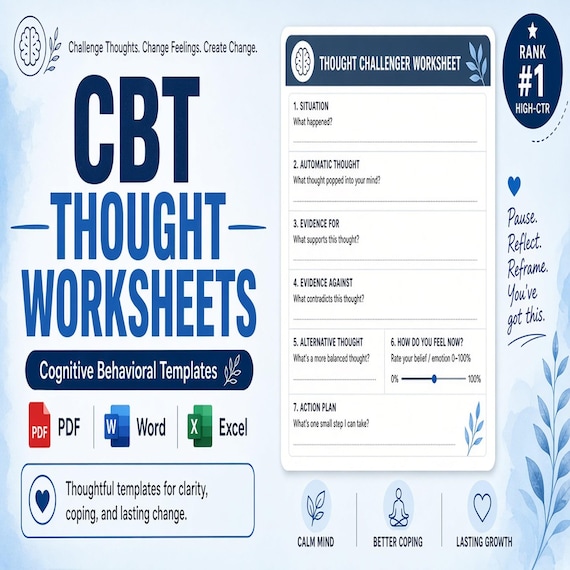
The current SteadyStackStudio listing describes a 31-page printable PDF workbook with 28 unique worksheet or form pages, a PDF quick-start guide, and a README with license information. The listing photos are described as renders of the actual included PDF pages, so use those inside-page previews to judge the prompt order, writing space, type size, and page density before checkout.
This package is described as a printable PDF kit, not an editable Word or Excel workbook. It can be used by printing selected pages or by annotating them in a compatible PDF app. Do not assume the file has fillable form fields, automated scoring, saved dashboards, or editable source text unless the current listing explicitly adds those features. If typing directly into fixed PDF pages is essential, test your preferred annotation app with another PDF before deciding the format fits.
The package includes both a Quick Thought Record and a Full Seven-Part Thought Record, along with focused pages such as Evidence For / Evidence Against, Balanced Thought Builder, Cognitive Distortion Sort, and several pattern-specific reframing sheets. That range is useful only if you choose pages by purpose instead of treating page count as a completion target.
- I can open standard PDF files on the device I plan to use.
- I am comfortable printing selected pages or writing in a PDF annotation app.
- The direct page previews show enough writing room for my needs.
- I do not need an editable DOCX, spreadsheet, app, or automated tracker.
- The current personal or single-practice/client-use license fits my intended use.
Choose the Quick Thought Record or the Full Seven-Part Thought Record
Use the Quick Thought Record when the main need is repetition. It can be a better starting point for learning the routine, reviewing a lower-intensity moment, or capturing an example while the details are still clear. A shorter page also makes it easier to notice which step is confusing before adding more prompts.
Use the Full Seven-Part Thought Record when the example needs more room and you can give the process unhurried attention. A fuller page is usually a better fit when several interpretations are competing, the evidence is mixed, or a completed record will be reviewed with a trained professional. Check the actual preview for the included field order rather than assuming every seven-part form uses identical labels.
The two pages are alternatives, not a required sequence. You do not need to copy a completed quick record onto the full form merely to make the work look more complete. Move to the longer page only when the extra structure answers a real question that the short page could not hold.
- Quick page: useful for first practice, brief review, or repeat use.
- Full page: useful when the event, meanings, and evidence need more space.
- Choose before writing so the format supports the moment instead of interrupting it.
- Do not measure progress by the number of boxes or pages completed.
Describe the situation before interpreting it
Begin with details another person could recognize: when the event happened, where you were, who was present, and what was said or done. Keep this part short. “My manager moved our check-in from Tuesday to Thursday” is easier to examine than “my manager does not respect me,” because the first sentence records an event and the second is already an interpretation.
This is not about pretending context does not matter. It is about giving facts and meanings separate places on the page. When they are mixed together, the later evidence step becomes circular: the interpretation is used as proof of itself. When they are separated, you can still take the concern seriously while asking what the available information does and does not establish.
If several events are tangled together, choose the first turning point and save the others for separate records. One page about a changed appointment, another about the follow-up conversation, and another about a later decision will usually be clearer than one crowded record labeled “the whole situation.”
- Record what happened in a few observable details.
- Leave motives, predictions, and conclusions for later prompts.
- Use direct words or actions when they matter, without writing a full transcript.
- Split a chain of events into separate records when each moment raises a different question.
Capture the thought as a sentence you can actually test
Write the thought in the form it appeared rather than polishing it into formal language. “I am going to embarrass myself,” “they must be annoyed,” or “if I cannot do this perfectly, I have failed” is more workable than a vague label such as “negative thinking.” The exact sentence shows what prediction, rule, or meaning the later evidence page needs to examine.
There may be more than one thought. List them briefly, then choose the one that carries the most weight or most directly shapes the next action. Trying to challenge five thoughts at once often produces a generic response that fits none of them. The remaining thoughts can be saved for another page if they still matter after the first record is complete.
When the selected form includes emotion or intensity fields, use them as a snapshot rather than a grade. The number does not prove that a thought is true or false, and it does not need to reach zero for the page to be useful. Its main value is helping you compare the moment before and after you have looked at the information more carefully.
- Use the thought’s original wording when you can remember it.
- Choose one main thought, prediction, or rule for the current record.
- Treat ratings as observations, not scores you must improve.
- Leave room for uncertainty instead of forcing an immediate conclusion.
Build a three-page starter set for a difficult example
A useful first packet can be smaller than the full workbook. Start with either the Quick Thought Record or the Full Seven-Part Thought Record. Add the Evidence For / Evidence Against page when the main thought needs a cleaner fact check. Add the Balanced Thought Builder when the evidence is mixed and you need room to write a response that holds more than one part of the situation.
This three-page structure prevents a common setup problem: reaching for a specialized worksheet before the core thought is clear. A Catastrophe Scale, Mind Reading Reality Check, or All-or-Nothing Reframe may be useful later, but the basic record should first show what happened, what the mind concluded, and what information is available. Otherwise the specialized page can become a label-searching exercise rather than a careful review.
Keep a clean original of each page and work from copies. If the shorter record answers the question, stop there. If the evidence page reveals a second issue, note it for a separate record instead of extending the current packet until it becomes exhausting.
- Page one: Quick Thought Record or Full Seven-Part Thought Record.
- Page two when needed: Evidence For / Evidence Against.
- Page three when needed: Balanced Thought Builder.
- Add a pattern-specific sheet only when it solves a question the core record identified.
Test evidence without turning the page into a debate
Evidence should be specific enough to check. Direct observations, relevant records, past examples, and clear statements belong in this step. A feeling can be important information about your experience, but the strength of a feeling does not automatically confirm a prediction about another person, the future, or your own ability.
On the “for” side, include information that genuinely supports the thought rather than making the case artificially weak. On the “against” side, include exceptions, missing information, other plausible explanations, and examples that do not fit the original conclusion. The point is not to win against yourself. It is to make the information set wider and more accurate.
Avoid filling both columns with assumptions. “They did not reply for two hours” is an observation. “They ignored me because they are angry” is one interpretation. “They are definitely busy” is another interpretation, not automatically a fact. A careful record can say that the reason is unknown and identify what reasonable next step could clarify it.
- Use observations, records, direct statements, and relevant past examples.
- Include real supporting information instead of weakening the original thought on purpose.
- Name what is unknown rather than replacing one certainty with another.
- Ask what information would change the conclusion in either direction.
Write a balanced thought instead of a forced positive statement
A balanced thought should fit the available information and feel believable enough to use. It may acknowledge discomfort, risk, disappointment, or responsibility while reducing conclusions the evidence cannot support. “This conversation may be awkward, and I can prepare one question and listen to the answer” is more grounded than either “it will be a disaster” or “everything will be perfect.”
Use plain language. A response that sounds like a slogan may look encouraging on paper but disappear when the situation returns. A practical balanced statement often includes three pieces: what is known, what remains uncertain, and what can be done next. It does not have to erase emotion or guarantee an outcome.
Read the sentence once as if it were written for someone you care about. If it dismisses the concern, revise it. If it repeats the original conclusion with softer words, return to the evidence. If it is accurate but too long to remember, write a shorter version below it for later use.
- Keep the response accurate rather than automatically optimistic.
- Include uncertainty when the evidence does not settle the question.
- Add one workable next action when action is appropriate.
- Use wording you could understand during the same kind of moment.
Use the Cognitive Distortion Sort as a lens, not a verdict
The included Cognitive Distortion Sort can help name a repeated thinking pattern after the main thought has been written. Use it to generate questions, not to declare that a concern is invalid. A thought may contain an all-or-nothing rule and still point to a real problem that needs attention. The label does not replace the situation, evidence, context, or professional judgment.
Choose one pattern that clearly connects to the sentence on the record. If the thought predicts the worst possible outcome, the Catastrophe Scale Worksheet or Probability Re-Estimate may be the next useful page. If it assumes another person’s private judgment, the Mind Reading Reality Check may fit. If it uses rigid demands, the Should Statement Rewrite may be more relevant.
The current workbook also lists pages for personalization, overgeneralization, all-or-nothing thinking, alternative explanations, core beliefs, and a best-friend reframe. Those are separate tools for separate jobs. Do not complete each one simply because it is included; select the smallest page set that addresses the pattern you actually noticed.
- Name a pattern only after writing the specific thought.
- Use one matching worksheet rather than a stack of every related page.
- Keep valid concerns and contextual information visible.
- Return to the core record if the label creates more certainty instead of more curiosity.
End with a small check or next action
A completed record does not need to end with a dramatic insight. It can end with a question to ask, a fact to verify, a task to break down, a boundary to communicate, or a decision to revisit with support. When no action is needed, the next step may simply be to keep the balanced statement available and notice what happens the next time the prediction appears.
Make the action observable and proportionate. “Prepare the first two sentences of the email” is easier to review than “be more confident.” “Ask what the new deadline is” is clearer than “stop worrying.” The action is not proof that the balanced thought is correct; it is a reasonable way to gather information or move forward under uncertainty.
Set a review point only when it serves a purpose. At that review, ask whether the page clarified the situation, whether the balanced thought was usable, and whether another worksheet is actually needed. Do not turn the workbook into a daily performance score or require every uncomfortable thought to become a writing assignment.
- Choose one action that can be seen, asked, checked, or scheduled.
- Keep the step small enough to fit the current situation.
- Review usefulness rather than demanding a particular emotional result.
- Stop when the page has done its job.
Keep printing, annotation, privacy, and versions simple
For paper use, print one test page before producing a packet. Check margins, type size, contrast, and writing room with the pen you will actually use. Print only the selected pages, keep an untouched digital original, and label working copies by date if you expect to compare them later. The listing identifies a printable PDF but does not promise a mailed workbook or physical binder.
For digital use, open the PDF in the app and device you plan to use, test handwriting or text annotation on a blank copy, and confirm how the marked file is saved. Save a working copy under a new name so the clean original remains available. If the app flattens marks, changes page order, or stores files in an unexpected cloud folder, solve that before adding personal information.
Completed thought records may contain private details about health, work, relationships, or other people. Decide where files or paper pages will be stored, who may see them, and when old copies should be securely removed. Professionals should follow their own consent, documentation, privacy, retention, supervision, and organizational requirements rather than treating a purchased worksheet as a complete recordkeeping policy.
- Keep one clean source copy and make dated working copies.
- Test one printed or annotated page before setting up the full packet.
- Store completed pages according to their sensitivity, not their convenience.
- Do not place identifying clinical details into a worksheet unless the approved workflow allows it.
Compare neighboring worksheet packs by the job you need
Choose the CBT thought-challenging workbook when the main task is examining a specific thought, checking evidence, considering alternatives, and writing a balanced response. Choose the depression-cycle and behavioral-activation workbook when the main task is mapping an activity pattern and planning small actions. Choose the anxiety pack when quick grounding, worry sorting, or repeat-practice pages are the better first need.
A DBT skills workbook is a different fit when the priority is practicing a named coping or regulation skill. An ACT workbook is different again when the work centers on values, willingness, defusion, and committed action rather than debating thought content. Couples and narrative products support still other page jobs. Comparing the primary task prevents several related workbooks from becoming an overlapping stack.
Before checkout, reopen the actual CBT page previews and confirm the quick record, full record, evidence page, balanced-thought page, print density, PDF format, and usage terms fit your plan. This workbook is an educational, organizational, and self-reflection resource. It is not medical advice, diagnosis, mental health treatment, crisis support, legal advice, or a substitute for a qualified professional’s judgment and care.
- Choose by the next page job, not by the largest page count.
- Check inside-page previews and file format before relying on the cover.
- Use only the pages that fit the setting and your approved scope.
- Skip the purchase when the format, prompts, license, or level of support does not fit.
Printables used in this guide
Instant downloads from the SteadyStackStudio Etsy shop.
CBT Worksheets
CBT Worksheets with Thought Record Worksheet, Cognitive Distortions, Thought Challenging & Cognitive Restructuring Therapy…
Depression Workbook
Depression Workbook with CBT Behavioral Activation Worksheets, Depression Cycle, Mood Tracker, Activity Schedule Printable PDF.
Anxiety Workbook
Anxiety Workbook with Anxiety Coping Skills Worksheets, Grounding Cards, CBT Anxiety Worksheets Therapy, Anxiety Thermometer…
DBT Worksheets Bundle
DBT Worksheets Bundle with DBT Skills Emotion Regulation, Distress Tolerance, Wise Mind, Mindfulness Coping Skills Therapy…