Therapy Worksheets · Jul 29, 2026 · 12 min read
Inner Child Workbook Setup: Choose One Page, Pace Reflection, and Close with Care
A calm, practical way to choose one inner child workbook page, protect privacy, pace reflective writing, pause when needed, and close each session with care.

Confirm what the current workbook includes and what it cannot do
Start with the actual package rather than assuming every inner child or shadow work download has the same pages. The featured product is described as a 31-page printable PDF workbook/form kit with 28 unique worksheet or form pages, a separate quick-start PDF, and a README/license note. Its current listing says the preview images are rendered from the included PDF files. It is an instant digital download, so no printed workbook or physical supplies are shipped.
The named pages range from Younger Self Letter, Photo / Memory Reflection, and Needs I Learned to Hide to Inner Critic Translator, Compassionate Response Page, Safe Adult Self Plan, Comfort Inventory, Joy Memory Page, Old Rule / New Choice Map, Boundary Practice Sheet, and Repair Promise to Myself. That range does not mean every page belongs in one sitting. The product is for education, organization, and self-reflection; it is not medical advice, diagnosis, mental health treatment, or crisis support. Review the current previews, file details, and scope before deciding whether it fits the way you want to reflect.
- Expect PDF files, not an editable Word document or a physical workbook.
- Check several inside-page previews instead of judging the download from its cover.
- Treat the page list as a menu, not a requirement to complete all 28 worksheets.
- Choose qualified support for needs that are beyond a self-reflection printable.
Decide whether self-guided reflection fits today
Before opening a prompt, ask what kind of support is available and what you hope the page will help you notice. A calm curiosity such as “I want to understand one recurring self-critical phrase” is a clearer starting point than “I need to uncover everything today.” You can also decide that today is better for a lighter comfort, joy, or curiosity page than for a memory or pattern-origin page. Choosing less intensity is still a complete decision.
Self-guided writing is not an obligation. If the subject already feels overwhelming, unsafe, confusing, or likely to leave you without enough support afterward, set the workbook aside. A therapist or another appropriately qualified professional can help decide whether a particular exercise belongs in supported work. If you are using the workbook in a professional setting, remain within your training, consent process, documentation rules, and local requirements; the blank page does not establish those standards for you.
- Name one reason for opening the workbook today.
- Choose a lighter page when deeper memory work does not feel appropriate.
- Leave a prompt blank when it asks for more than you want to share or explore.
- Do not use completion as proof that you are ready for a difficult subject.
Protect the original and choose a private working format
Keep the original download in a clearly named folder and make a separate working copy. The listing says selected pages can be printed or annotated in a PDF app, so choose the format that gives you enough writing room and the level of privacy you need. If you print, begin with one test page and check scale, margins, contrast, and whether your answers can fit. If you annotate digitally, test saving and reopening a disposable note before writing anything personal.
Decide where completed pages will live before you fill them. A shared printer tray, an automatically synchronized folder, a borrowed tablet, or an unfamiliar annotation service may expose writing you intended to keep private. Use device locks, storage choices, and disposal methods appropriate to the sensitivity of your notes. Professionals should also decide whether a completed page is a take-home handout, working exercise, or part of a record before identifiable information is added. The download provides pages; it does not make privacy or recordkeeping decisions.
- Archive one untouched copy of the purchased files.
- Print or duplicate only the page you plan to use now.
- Test the PDF app or printer with non-sensitive text first.
- Choose secure storage and disposal before adding personal details.
Build a gentle page sequence instead of starting with the hardest memory
The current page list allows a gradual route through the workbook. You might begin with Comfort Inventory, Joy Memory Page, or Play and Curiosity List to notice present-day sources of steadiness and interest. A later session could use Inner Critic Translator beside Compassionate Response Page. Pages such as Photo / Memory Reflection, Pattern Origin Reflection, Needs I Learned to Hide, or Trigger-to-Younger-Part Map can wait until the setting and support feel appropriate.
This is an organizational sequence, not a clinical progression and not a promise that one page will feel easier for everyone. Preview each prompt before writing, notice your reaction, and choose from the actual wording in the file. Create a small “now,” “later,” and “not for me” list if that helps. You may move a page between those groups at any time. The goal is to keep choice visible so curiosity does not turn into pressure.
- Preview the prompt before committing to it.
- Start with comfort, joy, play, or curiosity when that is the better fit.
- Save memory and pattern pages for a setting with enough support.
- Keep a visible “not for me” option for any page.
Give one page one purpose
Choose one worksheet and finish this sentence before you begin: “For this page, I only want to notice…” A narrow purpose might be one phrase your inner critic repeats, one activity that used to feel playful, one present-day comfort you can access, or one old rule you are reconsidering. The purpose should match the printed prompt rather than turning a single page into a demand to explain your entire history.
Set a personal stopping boundary as well. It can be the end of one page, a point in your schedule, or the moment when your writing stops feeling useful. There is no universal amount of time or number of sentences that makes reflection successful. Do not continue merely because blank space remains. A partly completed worksheet can still preserve the observation you wanted, and a dated note such as “return only with support” can be more useful than filling the page while distressed.
- Name one observation, question, or present-day need for the page.
- Keep the purpose smaller than your whole life story.
- Choose a stopping boundary before you start writing.
- Let unused space remain blank when the useful work is complete.
Set a clear beginning and ending container
Make the session easy to enter and easy to leave. Choose a place where you are unlikely to be interrupted, gather the one page and writing tool you need, and put away unrelated prompts. Note the current date and the page title. If having a trusted person available afterward would help, arrange that before you begin rather than deciding in the middle of a difficult response.
Plan the close at the same time as the start. Leave enough room after writing to put the page away, drink water, stretch, step outside, prepare a meal, or return to another familiar routine that works for you. Avoid opening an intense prompt immediately before a task that requires your full attention if you already know reflective writing can linger. The container is not a treatment technique or a guarantee against discomfort. It is a practical way to avoid letting one worksheet take over the rest of the day by accident.
- Use one page in a low-interruption setting.
- Write the date and page name before adding personal notes.
- Arrange any wanted support before beginning.
- Reserve a normal transition activity for after the page is closed.
Write without forcing certainty
Reflective prompts can bring up memories, impressions, family stories, emotions, and present-day interpretations. They do not all carry the same certainty. Use language that matches what you actually know: “I remember,” “I was told,” “I notice,” “I wonder,” or “I am not sure.” If a memory is unclear, do not treat the worksheet as a test that must produce a complete answer. Record uncertainty or leave the line blank.
Keep observation separate from conclusion. You can write that a particular phrase brings up sadness or that a situation resembles an older pattern without diagnosing yourself or another person. You also do not have to identify one cause for every reaction. The page is a place to notice and organize, not evidence that proves an event, motive, diagnosis, or family narrative. If the writing raises questions with legal, medical, safeguarding, or clinical consequences, take those questions to the appropriate qualified source rather than trying to settle them through a printable.
- Label memories, secondhand stories, current observations, and questions honestly.
- Use “not sure” instead of creating an answer to fill a box.
- Describe your experience without assigning an unsupported diagnosis or motive.
- Take consequential questions outside the workbook for qualified review.
Pair a difficult observation with a compassionate response
The included Inner Critic Translator and Compassionate Response Page can be given separate jobs. First, write the critical phrase as accurately and briefly as you can. Then ask what fear, rule, or protective intention may sit behind it without excusing harm or pretending you know more than you do. On the compassionate page, answer in language you would consider fair, specific, and believable—not a slogan you reject as soon as you read it.
A useful response can acknowledge both difficulty and choice: “That mistake was painful, and I can correct one part without insulting myself,” or “I learned to stay quiet, and I can decide where speaking is safe now.” Keep the response in the present tense and within your control. Self-compassion does not require approving every decision, reconciling with anyone, or erasing accountability. It gives the observation a humane next sentence so the page does not end with the harshest voice in the room.
- Capture one critical phrase instead of a long catalogue of faults.
- Translate the possible rule or fear without presenting it as fact.
- Write a fair response that you can actually believe today.
- Keep compassion compatible with boundaries, repair, and accountability.
Turn insight into one present-day boundary or choice
Pages such as Old Rule / New Choice Map, Boundary Practice Sheet, Safe Adult Self Plan, and Repair Promise to Myself can help move a reflection toward the present. Choose one old rule that appeared in your writing and describe a small alternative you control. “I must answer immediately” might become “I can read the message and respond after I have checked my schedule.” “I should never need help” might become “I can name one task and ask one suitable person.”
Keep the next step modest, lawful, and respectful of other people’s boundaries. A worksheet cannot promise how another person will respond, authorize a confrontation, or decide whether contact is safe. You may practice wording privately, postpone action, or bring the page to a qualified professional. If repair is appropriate, distinguish what you can acknowledge or change from the outcome you hope someone else will provide. A present-day choice is useful when it is clear enough to try and flexible enough to revise.
- Convert one old rule into one current option.
- Choose an action within your control rather than a required response from someone else.
- Practice boundary wording privately before deciding whether to use it.
- Bring complex safety, relationship, or treatment questions to appropriate support.
Pause and return to the present when the page is too much
Stop if writing becomes more intense than you are willing or able to continue with safely. Put down the pen, close or turn over the page, and notice ordinary facts about the present: where you are, the date, what you can see around you, and what you planned to do next. Use a familiar coping or support step that is already appropriate for you. You do not need to finish a sentence before pausing, and you do not owe the workbook another attempt.
Decide later whether the page should be skipped, revisited with qualified support, or removed from your working set. Do not use the workbook as crisis support. If you believe you may harm yourself or someone else, are in immediate danger, or cannot stay safe, contact local emergency services or an appropriate crisis service where you are. A digital download cannot assess risk or provide urgent care. Closing the page and seeking real-time help is not failure; it is a change to the plan based on what is needed now.
- Stop before completing the page when continuing does not feel safe or useful.
- Reorient to your present place, date, surroundings, and next ordinary task.
- Use support that is already suitable for you rather than improvising through a crisis.
- Seek urgent local help when there is immediate danger or you cannot stay safe.
Close, store, and review without scoring yourself
End with a short closeout note: the page used, one thing noticed, what you need next, and whether you plan to return. The answer can be “nothing more today.” If the page names a practical step, copy only that step to the place where you manage current tasks; do not carry an entire private reflection into a shared calendar. Then store, lock, shred, or delete working material according to the privacy decision you made at the start.
When you review later, look for usefulness rather than a score. Did the page help name something accurately? Did it suggest a kinder response, a question for support, a boundary to practice, or a reason not to use that prompt again? Add a date to changed conclusions so an older page is not mistaken for your current view. You may repeat a page, choose another, or stop using the workbook. Progress is not the number of blanks filled, and a printable should not become another system for criticizing yourself.
- Record one observation and one next need, including no further action.
- Move only a practical step—not private context—into a shared task system.
- Store or dispose of completed pages according to their sensitivity.
- Review usefulness and fit instead of counting completed worksheets.
Choose the focused workbook or an adjacent worksheet product
Choose the featured Inner Child Workbook when the current previews and page list match a self-reflection routine built around younger-self letters, memories, hidden needs, inner-critic translation, compassionate responses, comfort, play, old rules, boundaries, and present-day choices. Its current product details describe a PDF-only workbook with a quick-start guide and 28 unique worksheet or form pages. Skip it if you need a physical book, editable Word pages, crisis help, a diagnosis, or individualized treatment.
Choose the Depression Cycle Workbook when the named task is mapping a depression cycle and organizing behavioral-activation pages; the Anxiety Coping Skills Workbook when the current product details better match coping and grounding pages; or the CBT Thought Challenging Worksheets when the specific job is structured thought review. Choose the Narrative Therapy Worksheets Mega Bundle when a broader set of narrative prompts and counseling tools is the better fit, or the Couples Communication Workbook when conflict repair and communication are the actual focus. Compare the current titles, previews, included files, audience, and scope before checkout, and choose the smallest complete download that fits the work you intend to do.
- Use the inner child workbook for its stated reflection, compassion, comfort, rule, and boundary pages.
- Use a focused depression, anxiety, or CBT product when that named worksheet task is the real need.
- Use narrative or couples materials only when their audience and purpose match.
- Confirm the latest product details and choose professional or urgent support when a printable is not enough.
Printables used in this guide
Instant downloads from the SteadyStackStudio Etsy shop.
Inner Child Workbook
Inner Child Workbook with Inner Child Healing Journal, Self Compassion, Shadow Work Prompts, Emotional Healing Printable PDF.
Depression Workbook
Depression Workbook with CBT Behavioral Activation Worksheets, Depression Cycle, Mood Tracker, Activity Schedule Printable PDF.
Anxiety Workbook
Anxiety Workbook with Anxiety Coping Skills Worksheets, Grounding Cards, CBT Anxiety Worksheets Therapy, Anxiety Thermometer…
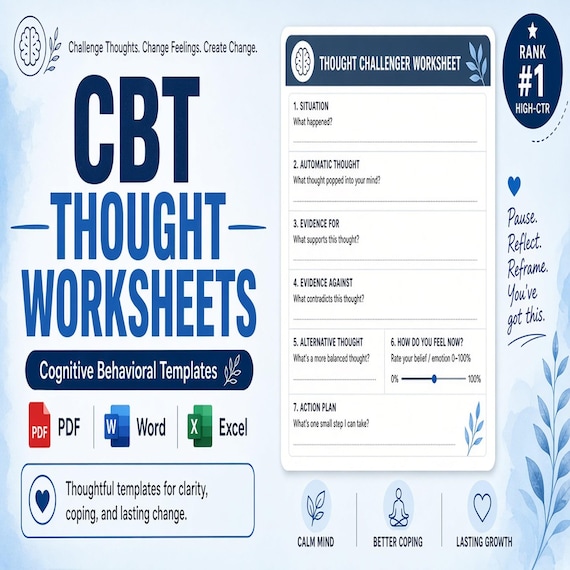
CBT Worksheets
CBT Worksheets with Thought Record Worksheet, Cognitive Distortions, Thought Challenging & Cognitive Restructuring Therapy…