Therapy Worksheets · Aug 16, 2026 · 14 min read
How to Choose Anxiety Workbook Pages: Grounding Cards, Trackers, and Practice Plans
A practical guide to choosing a small, purposeful set of grounding cards, pattern trackers, and repeat-practice pages from an anxiety coping skills PDF instead of printing the entire workbook at once.
Choose the page job before choosing the page
An anxiety workbook can contain quick-reference cards, observation pages, practice logs, planning sheets, and reflection pages. Those formats may share the same theme, but they do different jobs. A grounding card is designed to keep a short prompt easy to find. A tracker records a pattern over time. A practice log gives one repeated exercise a consistent place. A planning page helps organize preparation and review. Printing all of them at once can make a useful download feel like an assignment instead of a resource.
Begin by naming one practical job. You might need a small card that can be read without searching through a binder, a page for noticing body cues and intensity, or a simple record of which practice was tried and what was observed. Pick the page whose layout fits that job. Do not choose by the most serious-sounding heading, and do not assume every included worksheet is appropriate for every person or setting.
A printable can organize reflection and practice, but it cannot diagnose anxiety, determine what a symptom means, create an individualized treatment plan, or provide crisis support. Personal users should stay within the product's educational and self-reflection scope. Professionals should select and adapt pages according to their training, role, policies, informed-consent process, and the needs of the person in front of them.
- Quick prompt: choose a short card or menu that is easy to locate.
- Pattern spotting: choose one tracker with a clear date, situation, and observation area.
- Repeated practice: choose one log that can be used consistently without extra setup.
- Preparation and review: choose a planning sheet only when its purpose and follow-up are clear.
Check the file package before you plan a packet
The featured SteadyStackStudio Anxiety Coping Skills Workbook is described as a 31-page printable PDF kit with 28 unique worksheet or form pages, a PDF quick-start guide, and a README and license note. It is a digital download, not a physical workbook. The listing says selected pages can be printed or annotated in a PDF app. It does not list an editable Word file or spreadsheet, so a customer who needs extensive text changes should not assume those formats are included.
The named pages cover several roles: an Anxiety Pattern Map, Body Cue Tracker, Anxiety Thermometer, 5-4-3-2-1 Grounding Card, Breathing Practice Log, Worry Time Planner, Worry vs. Problem Sort, Control Circle Worksheet, Panic Wave Plan, Safety Behavior Inventory, Avoidance Cost Map, Tiny Exposure Ladder, Exposure Prep and Reflection sheets, Coping Skills Menu, and Calm Environment Checklist. That range is useful only when the intended pages match the actual purpose.
Before checkout, inspect the current listing description and direct page previews. Confirm that the PDF opens on the intended device, that the writing space and text size look workable, and that the license fits the planned use. If the file will be printed, test one non-sensitive blank page before committing paper and ink to a larger packet.
- Included format shown: printable PDF pages plus PDF support files.
- Use shown: print selected pages or annotate them in a PDF app.
- Delivery shown: instant digital download; no physical item is shipped.
- Do not assume: editable Word, spreadsheet, custom clinical review, or a mailed binder.
Use quick-reference pages for short, easy-to-find prompts
A quick-reference page earns its place by being brief and easy to locate. In the featured workbook, the 5-4-3-2-1 Grounding Card, Coping Skills Menu, and Calm Environment Checklist are examples of pages that can serve as prompts rather than long records. They may fit a front pocket, a session folder, or a clearly named digital favorites folder better than the middle of a full workbook.
Check the preview for legibility before printing smaller than the original layout. A card that becomes cramped or faint after scaling is not more convenient. If a page is intended for screen use, open it on the actual phone, tablet, or computer and confirm that it can be found without scrolling through dozens of pages. Keep the blank source file untouched so a clean copy is available later.
A prompt card is not an emergency plan and should not be presented as one. It does not decide whether a technique is suitable, explain the cause of distress, or replace contact with an appropriate professional or emergency service. Its practical value is narrower: it keeps an already chosen prompt visible when opening a full packet would add friction.
- Print or save only the prompt that has a clear, appropriate purpose.
- Keep the title readable and the steps visible at the intended size.
- Store the prompt where it can be found without exposing private notes.
- Separate quick-reference prompts from crisis, medical, and professional instructions.
Choose one observation page when the pattern is still unclear
Observation pages are useful when the immediate task is to describe what is happening rather than to complete a large set of exercises. The Anxiety Pattern Map, Body Cue Tracker, and Anxiety Thermometer each offer a different frame. A pattern map can connect situations, responses, and repeated sequences. A body-cue page can keep physical observations in one place. A thermometer can provide a consistent personal scale when the same scale is used and understood over time.
Do not stack several trackers that ask for nearly the same information. Duplicate recording usually creates incomplete pages and inconsistent labels. Choose the page with fields that answer the current question, decide how often it will be used, and set a short review point. If the entries are not helping the intended reflection or professional conversation, stop adding rows simply because the page exists.
Use descriptive language rather than turning one entry into a conclusion. A printable observation is not a diagnosis, measurement instrument, or medical record. A professional user should follow applicable documentation and privacy requirements; a personal user should avoid recording identifying or sensitive information in a device, app, or shared folder that is not appropriate for it.
- Pattern Map: consider it when the sequence around a recurring situation is the main question.
- Body Cue Tracker: consider it when consistent, factual body observations need a place.
- Anxiety Thermometer: consider it when one clearly defined personal scale will be reviewed over time.
- Use one primary tracker and retire duplicates that do not change the next useful conversation.
Separate a worry from a problem before selecting the next sheet
The Worry vs. Problem Sort and Control Circle Worksheet are decision pages rather than simple logs. Their practical role is to sort information into clearer buckets so the next step is easier to see. A concrete problem may have a specific action, owner, or date. A hypothetical worry may need a different kind of response. A control-circle page can distinguish a direct action from an influence, uncertainty, or circumstance outside one person's control.
These sheets should reduce clutter, not pressure someone to produce certainty. Leave room for “not sure yet,” and do not force a complicated situation into a box that does not fit. If a page produces arguments about the correct category, return to a plain description of the situation and seek appropriate support rather than treating the worksheet label as the answer.
For a small starter packet, choose either the sort page or the control-circle page first. Use it for one clearly bounded example, then decide whether its structure was helpful. Reprinting a fresh blank is often cleaner than carrying forward a crowded page whose categories no longer match the situation.
- Choose the sort page when the main task is distinguishing an actionable problem from a hypothetical concern.
- Choose the control-circle page when the main task is separating direct action from influence and uncertainty.
- Keep uncertain items visible instead of forcing a false answer.
- Use the page as an organizing aid, not as proof that a concern is unimportant.
Pick one repeat-practice log and define what will be reviewed
A practice log is different from a quick card. It is useful when the same activity will be repeated and someone knows what information matters afterward. The featured workbook names a Breathing Practice Log and a Worry Time Planner. Before printing either one, decide whether the goal is simply to remember that a practice occurred, to note context and observations, or to prepare information for a professional conversation.
Keep the recording burden lighter than the practice itself. A date, a short context note, and one factual observation may be more sustainable than a long narrative after every attempt. Avoid inventing a scoring system that the page does not explain. If a personal scale is used, label it consistently so a later entry can be understood. Stop using the log if it becomes a source of pressure or repetitive checking rather than a useful record.
The right log is the one that will actually be reviewed. Set a clear review point, such as after a small number of entries or at the next appropriate appointment or session. Professionals should decide whether any completed page belongs in their approved record system; the download itself is not an electronic health record or a documentation-compliance tool.
- Choose one practice page rather than beginning several competing logs.
- Record only the details needed for the stated review.
- Use consistent labels for dates, context, and any personal scale.
- Decide in advance when the page will be reviewed, archived, or discontinued.
Treat planning and exposure-related pages as a separate decision
The Panic Wave Plan, Safety Behavior Inventory, Avoidance Cost Map, Tiny Exposure Ladder, Exposure Prep Sheet, and Exposure Reflection Sheet form a more planning-heavy group. They should not be added to a starter packet merely because their headings sound important. Each one asks for judgment about purpose, timing, readiness, and follow-up that a blank PDF cannot supply.
A professional using exposure-related material should rely on relevant training, individualized assessment, informed consent, supervision where needed, and the person's current plan—not on the presence of a worksheet in a download. A personal-use customer should not treat the pages as instructions to push through intense distress or as a replacement for qualified care. If the situation involves urgent safety concerns, severe symptoms, or uncertainty about what is appropriate, the next step is suitable professional or emergency support rather than another printable page.
When a planning page is appropriate, preview its fields and decide how preparation and review will happen before it is printed. Keep it separate from quick grounding prompts so users can tell the difference between a brief reference and a structured activity that needs context.
- Do not select a planning page solely because its title sounds advanced or comprehensive.
- Confirm who will guide, review, or follow up on the completed page.
- Keep exposure-related sheets within appropriate personal or professional boundaries.
- Use qualified care or emergency resources when a printable is not an appropriate response.
Build a three-part starter packet instead of printing 31 pages
A small packet can make the workbook easier to test. Start with one quick-reference page, one observation or sorting page, and one repeat-practice or review page. That gives each sheet a separate job and keeps the packet small enough to understand at a glance. The exact combination should follow the intended use, not a universal sequence.
For example, a personal reflection packet might contain a selected grounding card, one Body Cue Tracker, and one Worry vs. Problem Sort. A trained practitioner might choose one appropriate prompt, one observation page, and one page that supports the work already being done. A school counselor or group facilitator might select a short prompt and a low-burden reflection page only when the materials fit the setting, consent process, age, accessibility needs, and local policies.
Label the packet with a neutral purpose and date rather than a diagnosis. Keep blank masters separate from completed pages. After the packet has been used, ask whether each sheet was easy to find, understandable, proportionate to the task, and worth repeating. Add a fourth page only when a real gap appears.
- Part 1: one brief prompt that is easy to locate.
- Part 2: one observation or sorting page for the current question.
- Part 3: one practice, preparation, or review page with a clear follow-up.
- Expansion rule: add another page only after the starter packet shows what is missing.
Choose printing or PDF annotation by the way the page will be used
The listing supports two basic workflows: print selected pages or annotate them in a PDF app. Paper can be useful when handwriting, side-by-side pages, or a simple folder is the easiest format. Digital annotation can reduce reprinting and make a page available on a compatible device. Neither approach is automatically more private, more accessible, or easier to maintain.
For paper, print one blank test page and check text size, contrast, margins, writing room, and whether scaling changes the layout. Decide where completed pages will be stored and how replaced pages will be removed from active use. For digital annotation, make a working copy instead of writing over the untouched download, confirm that annotations save and reopen correctly, and use an approved storage location with suitable access controls.
Use simple file names that do not expose private details. Add a date or version to working copies when that helps distinguish the current page. If pages are shared with an appropriate professional or approved participant, send only what is needed through the accepted method. A PDF worksheet should not become an informal substitute for a secure record system.
- Paper check: size, contrast, margins, writing space, storage, and version control.
- Digital check: app compatibility, saved annotations, backup, access, and current-copy naming.
- Keep an untouched master file so clean pages remain available.
- Limit completed-page access to the people and purpose that require it.
Compare adjacent worksheet packs by their primary page role
A general anxiety packet is not the same as every neighboring therapy worksheet bundle. The featured anxiety workbook mixes grounding prompts, worry and control sorting, pattern and body-cue tracking, practice logs, and planning pages. The trauma worksheet bundle is described around window-of-tolerance maps, grounding, arousal signals, support contacts, boundaries, and safety-oriented reminders. The DBT bundle centers named mindfulness, distress-tolerance, emotion-regulation, and decision-practice pages.
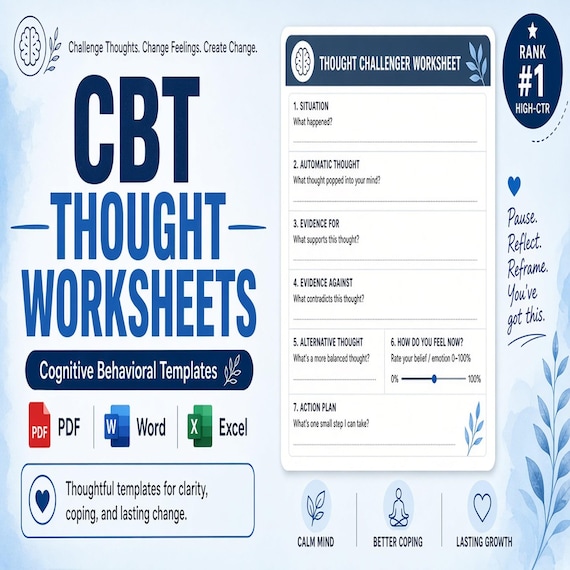
The CBT thought-challenging workbook is built around thought records, evidence review, balanced-thought work, cognitive-distortion pages, and related reframing tools. The depression-cycle workbook emphasizes mood and energy tracking, small-task and activity planning, pleasure and mastery, values-to-action pages, and routine review. The teen emotional-regulation workbook uses feelings language, body signals, school and friendship situations, calm-down choices, problem-solving steps, and support-request scripts.
Choose by the primary page role that matches the current educational, self-reflection, or professional task. Do not assume that similar words such as coping, grounding, emotion, or tracker make the packages interchangeable. Open the current previews, compare the named inside pages, and choose the smallest complete pack that fits the intended setting and level of support.
- General anxiety organization: compare grounding, worry, body-cue, practice, and planning pages.
- Trauma-informed stabilization resources: compare window-of-tolerance, grounding, support, boundary, and safety-oriented pages.
- DBT skills practice: compare the named mindfulness, distress-tolerance, emotion-regulation, and decision pages.
- CBT cognitive work: compare thought records, evidence review, and balanced-thought pages.
- Activation and routines: compare the depression-cycle workbook's activity, values, and daily-planning pages.
- Teen-focused language and settings: compare the emotional-regulation workbook's school, friendship, body-signal, and support pages.
Avoid the setup mistakes that make a useful PDF harder to use
The most common setup problem is turning a page library into a completion project. Printing every sheet creates visual weight, repeated questions, and pressure to fill pages that do not serve the current purpose. Another problem is keeping several similar trackers active at once. When dates, scales, and labels differ, the entries are difficult to compare and easy to abandon.
Version confusion matters too. A completed PDF on one device, a paper copy in a folder, and another copy sent by email can all look current. Decide which copy is active, date it when appropriate, and archive or destroy replaced versions according to the setting's requirements. Do not put sensitive details in a file name or leave completed pages in a shared download folder.
Finally, stay within the package's scope and license. The file is educational, organizational, and for self-reflection; it is not medical advice, diagnosis, treatment, legal guidance, documentation-compliance guidance, or crisis support. The listing allows personal use or single-practice/client use by the purchasing customer and says blank templates may not be resold, redistributed, shared, uploaded, or claimed as another product.
- Do not print the whole workbook before choosing a page role.
- Do not run several overlapping trackers without a clear reason.
- Do not let multiple completed copies compete as the current version.
- Do not use or distribute the files beyond the stated scope and license.
- Do not treat a completed worksheet as a diagnosis, treatment plan, or crisis resource.
Complete this fit check before checkout
A good purchase decision should be specific enough to name the first two or three pages you would use. Open the current product page and verify the 31-page PDF package, 28 unique worksheet or form pages, quick-start guide, README and license note, delivery method, and direct page previews. Confirm that the included page names match the job you identified and that PDF printing or annotation fits the intended device and routine.
Then check the support level. A self-reflection customer should be comfortable staying within a low-pressure educational use and knowing when the material is not enough. A practitioner, school counselor, or facilitator should already have the training, consent, privacy, documentation, and review process required for the setting. A printable should fit inside that process; it should not be expected to create the process.
Skip the download if you need a physical item, an editable Word or spreadsheet package, individualized professional guidance, guaranteed compatibility with an untested app or printer, a secure record platform, or urgent support. If the anxiety workbook is too broad or not focused on the page role you need, compare the adjacent packs rather than buying the largest bundle. The best fit is the smallest set of pages with a clear purpose, a safe context, and a realistic review plan.
- I can name the page job and the first small packet I would assemble.
- I have checked the current inside-page previews, PDF format, and delivery details.
- I know whether paper or PDF annotation will be easier to protect and maintain.
- I understand the educational scope, license, and limits of the download.
- I will choose another resource or appropriate support if this file does not match the task.
Printables used in this guide
Instant downloads from the SteadyStackStudio Etsy shop.
Anxiety Workbook
Anxiety Workbook with Anxiety Coping Skills Worksheets, Grounding Cards, CBT Anxiety Worksheets Therapy, Anxiety Thermometer…
Trauma Therapy Worksheets Bundle
Trauma Therapy Worksheets Bundle with Grounding Techniques, Safety Plan, Window of Tolerance, PTSD Coping Skills Printable PDF.
DBT Worksheets Bundle
DBT Worksheets Bundle with DBT Skills Emotion Regulation, Distress Tolerance, Wise Mind, Mindfulness Coping Skills Therapy…
CBT Worksheets
CBT Worksheets with Thought Record Worksheet, Cognitive Distortions, Thought Challenging & Cognitive Restructuring Therapy…