Therapy Worksheets · Aug 17, 2026 · 14 min read
Behavioral Activation Worksheet Setup: Map the Cycle, Plan Tiny Steps, and Review Activities
A practical setup guide for choosing a depression-cycle map, tiny-task planner, activity menu, before-and-after rating, and review log without printing the full workbook at once.
Start with one map–plan–review loop
A behavioral activation workbook is easier to use when its pages form one small loop: describe the current pattern, choose one realistic action, record what happened, and decide whether the setup was useful. That is a different job from completing every worksheet in order. A 31-page file can be a page library rather than a 31-step assignment.
Begin by naming the practical question the pages should answer. Do you need a clearer picture of a repeated cycle, a way to break one chosen task into smaller steps, a menu of possible activities, or a consistent place to review an activity afterward? Select the page whose fields match that question. If two pages ask for nearly the same information, start with one and leave the other in the blank master file.
These printables can organize education, self-reflection, and appropriately guided professional work. They do not diagnose depression, decide which activity is suitable, create an individualized treatment plan, or provide crisis care. Personal users should keep the task low-pressure and within the product's stated scope. Professionals should use the pages only within their training, policies, consent process, privacy requirements, and the needs of the person they support.
- Map: choose one page that describes the current pattern without trying to explain everything.
- Plan: choose one page that turns an appropriate goal into a specific next action.
- Review: choose one consistent log or rating page and decide when it will be checked.
- Keep the unused pages in the original file until a clear need appears.
Confirm the file package before planning your setup
The featured SteadyStackStudio Depression Cycle Workbook is currently described as a 31-page printable PDF workbook and form kit with 28 unique worksheet or form pages. The package also lists a PDF quick-start guide and a README and license note. It is an instant digital download, not a physical workbook, and the stated use is to print selected pages or annotate them in a PDF app.
The listed sample pages include a Depression Cycle Map, Mood + Energy Dashboard, Daily Minimum Plan, Tiny Task Ladder, Behavioral Activation Menu, Pleasure + Mastery Log, Values Compass, Values-to-Action Planner, Avoidance Pattern Check, Activity Before/After Rating, Morning Start Plan, Evening Shutdown Reflection, Low-Energy Meal/Body Care Plan, Sleep Routine Audit, Sunlight + Movement Tracker, and Support Circle Map. Those names show several page roles, so the right setup depends on the job rather than the total page count.
Before checkout, compare the current description with the direct page previews. Check text size, writing room, page orientation, and whether a printable PDF or PDF-annotation workflow fits the device and routine you will actually use. The listing does not state that an editable Word file or spreadsheet is included, so do not assume those formats are part of this package.
- Included format shown: printable PDF pages plus PDF support files and a license note.
- Delivery shown: digital download only; no printed workbook is shipped.
- Use shown: print selected pages or work from a copy in a compatible PDF app.
- Do not assume: editable Word pages, spreadsheet trackers, custom guidance, or a mailed binder.
Map the current pattern without turning the page into a conclusion
The Depression Cycle Map and Avoidance Pattern Check can both support a mapping step, but they should not automatically be used together. A cycle map may be the better first choice when the main task is to place a situation, response, short-term effect, and repeated pattern in one view. An avoidance check may fit when the narrower question is which situations or tasks are repeatedly postponed, escaped, or left unfinished.
Use plain, descriptive wording. Record what was noticed, when it occurred, and what happened next without treating one entry as proof of a cause or diagnosis. If a field does not apply, leave it blank rather than forcing the experience into the page's structure. A short, accurate map is more useful than a full page of guesses.
Set a review point before collecting more entries. If the page is for personal reflection, that may mean checking whether the map made the next planning decision clearer. If it is used in a professional setting, the practitioner should decide how the page is introduced, discussed, stored, and documented. The blank template itself does not make those decisions and is not a clinical record system.
- Choose the cycle map when the repeated sequence is the main question.
- Choose the avoidance check when the recurring postponed or escaped task is the main question.
- Describe observations and sequence; do not turn a worksheet entry into a diagnosis.
- Stop collecting entries when the page is not changing the next useful conversation.
Choose one planning page based on the size of the next action
The Behavioral Activation Menu, Tiny Task Ladder, Daily Minimum Plan, Values Compass, and Values-to-Action Planner all support planning, but they are not interchangeable. A menu can hold several appropriate options for later selection. A tiny-task ladder can divide one chosen task into smaller visible steps. A daily minimum page can keep a deliberately limited baseline in view. Values pages can help connect a chosen direction to one observable action.
Match the page to the decision that is currently stuck. If there are no options on the table, a menu may help organize possibilities. If the task is known but feels too large, the ladder may be the cleaner fit. If the plan keeps expanding beyond what can be maintained, a daily minimum page may help define a smaller boundary. If the action feels disconnected from what matters to the person, preview the values pages rather than adding another generic to-do list.
Use one primary planner for the first setup. Running a menu, ladder, daily minimum page, and values planner at the same time creates duplicate decisions and makes it hard to tell which page helped. Add another planning page only when the first one reveals a specific missing step.
- Menu: organize a short set of suitable activity options.
- Tiny Task Ladder: break one selected task into smaller observable steps.
- Daily Minimum Plan: define a deliberately limited baseline for the day.
- Values pages: connect a chosen direction to a concrete action without assuming a particular outcome.
Write a next step that can be seen and reviewed
A planning page becomes easier to use when the next step describes an action rather than a broad result. Phrases such as “get back on track,” “be productive,” or “feel better” do not show where the activity begins or when it is complete. A more workable entry names the first visible action, the intended setting or time window, and the point where the person will pause and review.
Keep the step small enough to understand without adding a second worksheet. For example, a customer might replace a broad project label with an appropriate first action such as gathering one needed item, opening the relevant document, or preparing the space for a later task. The exact activity should be chosen by the person or by a qualified professional working within an appropriate plan; the printable does not determine what is safe, suitable, or clinically indicated.
Leave room for a step to be revised. If it was unclear, too large, inaccessible, or not appropriate for the day, the review can record that without treating the entry as failure. The point of the written step is to make the setup testable and discussable, not to promise a particular mood or result.
- Name the first visible action instead of a broad outcome.
- Add only the context needed to know when or where the action starts.
- Define a natural stopping point so the task does not silently expand.
- Allow revision when the step is unclear, inaccessible, too large, or not appropriate.
Separate the plan from the review with one before-and-after page
The Activity Before/After Rating offers a dedicated review role. Use it only when there is a clear reason to record a consistent observation before and after the same activity. It should not become a promise that every rating will improve or a test that the person must pass. A neutral record can show that an activity was attempted, postponed, changed, or completed and what was noticed at the two chosen points.
Define any scale before using it and keep the labels consistent. A number without a label can mean energy on one day, mood on another, and difficulty on a third. If the page preview already provides labels or instructions, follow the page rather than inventing a competing system. If a scale is not useful or understandable, use a short factual note instead of creating false precision.
Choose a small review window. After a few appropriate entries, ask whether the page made planning or discussion clearer. If it only creates extra recording, retire it and preserve the blank master. Professionals should also decide whether the completed sheet belongs in an approved record and how it will be protected; a downloaded PDF is not an electronic health record.
- Use the same clearly labeled observation before and after the selected activity.
- Do not assume that a higher, lower, or unchanged rating has one universal meaning.
- Record changed or postponed plans honestly instead of filling the page to look complete.
- Keep the log only when someone will review and use the information appropriately.
Use the Pleasure + Mastery Log as a separate kind of review
The Pleasure + Mastery Log should not be treated as a duplicate of the Activity Before/After Rating. The first can organize two named qualities after an activity, while the second is structured around observations at two points in time. Choose the log whose layout answers the current question. Using both for every activity may create more paperwork without adding clarity.
Preview the page before deciding how its fields will be used. Keep “pleasure” and “mastery” distinct rather than combining them into a single good-or-bad score. An activity may be meaningful, difficult, neutral, unfinished, or experienced differently than expected. The worksheet should leave room for what was actually noticed instead of forcing both entries to rise.
Use consistent labels and a short review cycle. Look for whether the log helps compare activities or prepare a useful conversation, not whether it tells a perfect story. A printable record can support reflection, but it cannot establish why a person felt a certain way, prove that an activity caused a change, or decide the next clinical step.
- Choose either a pleasure-and-mastery review or a before-and-after review first.
- Keep the two named qualities separate and follow the page's visible instructions.
- Allow neutral, mixed, or unexpected observations without correcting them to fit a goal.
- Review a small set of entries before deciding whether the log deserves continued use.
Add routine-support pages only when they solve a specific gap
The featured workbook also lists a Morning Start Plan, Evening Shutdown Reflection, Low-Energy Meal/Body Care Plan, Sleep Routine Audit, Sunlight + Movement Tracker, and Support Circle Map. These pages broaden the package beyond one activity loop. They may be useful when the named routine or support question is genuinely part of the intended work, but they do not all belong in every starter setup.
Add one support page at a time. A morning page may fit when the first transition of the day needs a simple sequence. An evening reflection may fit when unfinished tasks and tomorrow's handoff need a place. A support-circle page may fit when the practical question is who can provide an appropriate kind of support. Pages involving body care, sleep, or movement should stay within the product's educational scope and should not replace medical advice or individualized professional guidance.
Keep each page connected to a clear owner and review. If no one knows who will look at a completed sheet or what decision it supports, leave it in the library. A smaller setup with three understood pages is usually easier to maintain than a binder of partially completed routine trackers.
- Add a morning or evening page only for that specific transition.
- Use a support map to organize appropriate contacts, not as an emergency response by itself.
- Keep sleep, body-care, meal, sunlight, and movement pages within suitable personal or professional boundaries.
- Remove a support page when its entries are not being reviewed or used.
Test a small page set before printing the complete workbook
A practical starter set can contain one mapping page, one planning page, and one review page. For example, someone might choose the Depression Cycle Map, Tiny Task Ladder, and Activity Before/After Rating when those layouts match the intended educational or professionally guided task. Another setup might use the Avoidance Pattern Check, Behavioral Activation Menu, and Pleasure + Mastery Log. These are examples of page roles, not universal treatment sequences.
Use the same small set long enough to learn whether the labels, writing space, and review flow make sense. Avoid changing the scale, page order, and file name after every entry. At the review point, check whether each sheet was easy to find, clear to complete, proportionate to the task, and worth using again. Keep, revise, or remove pages based on that practical fit.
Do not expand simply because more pages are available. Add the Daily Minimum Plan, a values page, or one routine-support sheet only when the starter set reveals a specific missing decision. This keeps the workbook from becoming another unfinished project and makes it easier to protect completed pages.
- Starter role 1: one map for the current pattern or repeated avoidance question.
- Starter role 2: one planner for the next suitable, observable action.
- Starter role 3: one review page with consistent labels and a clear review point.
- Expansion rule: add a page only when you can name the gap it fills.
Keep printing, PDF annotation, privacy, and versions simple
The listing supports printing selected pages or annotating the PDF in a compatible app. For paper use, print one blank test page and check margins, contrast, text size, and writing room before producing a larger set. Keep the untouched download separate from completed pages, and decide where current and archived sheets will be stored. Do not leave sensitive pages in an open printer tray or shared workspace.
For digital use, make a working copy instead of writing over the original. Confirm that the chosen app can save annotations and reopen them correctly. Use a plain version or date label that does not expose private details in the file name. Store completed copies only in a location appropriate for the information and intended use, with access limited to the people who need it.
Professionals should follow their approved privacy, documentation, retention, and disposal practices rather than treating a downloaded worksheet folder as a record system. Personal users should also consider who can access a shared device, cloud folder, email account, or home filing area. Format convenience is not the same as confidentiality.
- Paper check: margins, contrast, writing space, storage, and secure disposal.
- Digital check: app compatibility, saved annotations, access, backup, and current version.
- Keep a clean master so future pages are not copied from a completed sheet.
- Use file names and storage locations that do not reveal unnecessary private information.
Compare neighboring worksheet packs by the job of the page
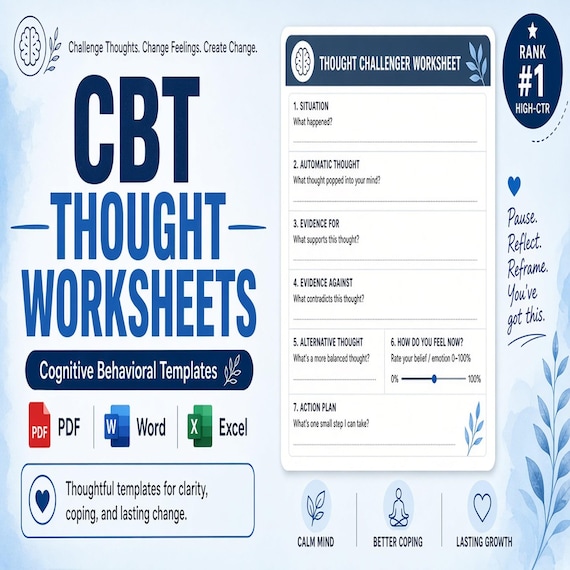
Choose the featured depression-cycle workbook when the current previews and page list fit mapping a repeated cycle, organizing tiny tasks and activity options, connecting values to action, recording before-and-after observations, or reviewing pleasure and mastery. Choose the CBT Thought Challenging Worksheets when the primary job is a thought record, evidence review, balanced-thought work, or cognitive-distortion sorting rather than activity planning.
The Anxiety Coping Skills Workbook is described around anxiety-pattern and body-cue tracking, grounding prompts, worry and control sorting, practice logs, and planning pages. The DBT Skills Workbook centers named mindfulness, distress-tolerance, emotion-regulation, and decision-practice pages. The ACT workbook combines values, defusion, willingness, present-moment, perspective, and committed-action pages and is listed with PDF, editable Word, and Excel formats. The grief workbook focuses on check-ins, memory and loss reflection, hard-day and anniversary planning, support, and related bereavement pages.
Open the current product previews rather than choosing by a shared word such as mood, tracker, coping, values, or workbook. Similar labels do not make the page flows interchangeable. The better fit is the smallest complete pack whose main page role, format, support level, and stated license match the way it will actually be used.
- Activity mapping and review: compare the depression-cycle workbook.
- Thought records and evidence review: compare the CBT thought-challenging workbook.
- Grounding and worry organization: compare the anxiety workbook.
- Named DBT skills practice: compare the DBT workbook.
- Values, defusion, and committed action with editable formats: compare the ACT workbook.
- Bereavement reflection and hard-day planning: compare the grief workbook.
Complete this fit check before you open Etsy
A good fit should be specific enough to name the first small page set you would use. Confirm the current 31-page printable PDF package, 28 unique worksheet or form pages, PDF quick-start guide, README and license note, digital delivery, and direct page previews. Make sure a PDF-only workflow works for the intended printer, device, writing style, storage plan, and level of support.
Check the scope as carefully as the page names. The product is described for educational, organizational, and self-reflection use. It is not medical advice, diagnosis, mental health treatment, documentation-compliance guidance, legal advice, or crisis support. A professional should already have the training, assessment, consent, privacy, documentation, and follow-up process required for the setting. A personal-use customer should know when a printable is not enough and seek appropriate qualified or emergency help when needed.
Skip this download if you need a physical workbook, editable Word pages, spreadsheet trackers, individualized guidance, a secure record platform, or urgent support. If the featured pages are close but not exact, compare the neighboring therapy worksheet products and the broader worksheet-bundle guide before checkout. Open Etsy only after the file format, first page set, license, storage plan, and practical use are clear.
- I can name the mapping, planning, and review pages I would try first.
- I checked the current inside-page previews, PDF format, and digital-delivery details.
- I know how blank masters and completed pages will be stored and protected.
- I understand the educational scope, stated license, and limits of the download.
- I will choose another resource or appropriate support if this file does not fit the task.
Printables used in this guide
Instant downloads from the SteadyStackStudio Etsy shop.
Depression Workbook
Depression Workbook with CBT Behavioral Activation Worksheets, Depression Cycle, Mood Tracker, Activity Schedule Printable PDF.
CBT Worksheets
CBT Worksheets with Thought Record Worksheet, Cognitive Distortions, Thought Challenging & Cognitive Restructuring Therapy…
Anxiety Workbook
Anxiety Workbook with Anxiety Coping Skills Worksheets, Grounding Cards, CBT Anxiety Worksheets Therapy, Anxiety Thermometer…
DBT Worksheets Bundle
DBT Worksheets Bundle with DBT Skills Emotion Regulation, Distress Tolerance, Wise Mind, Mindfulness Coping Skills Therapy…