Therapy Worksheets · Jul 13, 2026 · 11 min read
ACT Worksheets in Practice: Values, Defusion, and Committed Action
A practical guide for trained practitioners choosing and using ACT worksheet pages one process at a time, from values clarification and defusion to a small, observable committed action.
Confirm the audience and scope before choosing an ACT workbook
Acceptance and Commitment Therapy worksheets are not interchangeable with a general journal, motivational planner, or crisis resource. Begin by checking who the pages were designed for and what role they are meant to play. The matching SteadyStack download is described for trained therapists, counselors, social workers, coaches working within their scope, and supervised trainees using ACT principles. That audience statement matters: a clear layout can support a skilled conversation, but it does not supply the training, assessment, relationship, consent process, or professional judgment that gives the page its context.
Decide whether you need a client-facing exercise, a practitioner prompt, a reusable practice tracker, or an organizational page. Then compare the preview with the language and setting you actually use. A workbook may be a good fit when the practitioner already understands the model and wants a consistent way to move from observation to choice. It is not a substitute for individualized care, a treatment protocol, a diagnostic tool, a crisis plan, or an approved health-record system. If those distinctions are unclear, resolve them before purchase rather than expecting the download to define professional scope.
- Read the stated audience and professional-use notes before comparing page counts.
- Name the page role: exercise, prompt, practice record, or administrative tracker.
- Use worksheets only within the training, consent, and policies that already govern the work.
- Choose another resource when the immediate need is assessment, crisis response, or personalized advice.
Choose one ACT process for the current conversation
A broad ACT workbook can contain values, present-moment awareness, defusion, willingness, perspective, and committed-action pages. That does not mean every page belongs in one meeting or that the workbook should be completed from front to back. Start with the process that fits the person's stated concern, the current context, and the purpose of the conversation. A page is useful when it helps someone notice an experience, make room for choice, or take a workable next step. It is less useful when it becomes an assignment completed only because it appears next in the file.
Preview the workbook as a menu rather than a fixed curriculum. Identify which pages stand alone, which depend on practitioner explanation, and which create records that may need secure handling. Keep the first use small enough that both practitioner and client can review what happened. If a page creates confusion, shame, argument, or a sense of being tested, pause and reconsider the timing, wording, or choice of process. A good worksheet supports contact with the conversation; it should not pull attention away from the person in order to finish the form.
- Select one process because it fits the current purpose, not because it is first in the file.
- Treat the workbook as a menu of possible supports rather than a required sequence.
- Mark pages that need explanation or approved record handling before use.
- Review the effect of the page before adding another exercise.
Clarify values as directions rather than finish lines
Values pages become easier to use when values are separated from goals, outcomes, approval, and rules. A goal can be completed or missed; a value describes a chosen quality of action that can guide many different moments. For example, a person may value being attentive in an important relationship. One possible goal could be making time for a particular conversation, but the value is larger than that single event. The worksheet should leave room for the person's own language instead of offering a list that quietly turns into the correct answers.
Choose one life area rather than asking for a complete life map immediately. Explore what matters in that area, what acting in that direction could look like, and what gets in the way. Keep cultural, family, community, access, safety, and practical context visible. A values page should not imply that every desired action is currently possible or that difficult circumstances reflect weak commitment. The useful result is a direction the person recognizes as their own, expressed clearly enough to inform one next choice without becoming another standard for self-criticism.
- Keep values, goals, outcomes, and other people's expectations in separate fields.
- Work with one life area before expanding to a larger values map.
- Use the person's words and preserve the context that affects available choices.
- End with a direction that can guide action, not a score for how well someone is living.
Use defusion pages to notice thoughts without starting a debate
A cognitive defusion worksheet has a different job from a thought-challenging record. The aim is not necessarily to prove a thought false, replace it with a positive statement, or win an argument with the mind. A useful page can help a person notice the words, images, memories, or rules that are showing up and observe how tightly behavior is being organized around them. The practitioner can then explore whether holding that thought more lightly creates room for a chosen action in the present context.
Check the preview for plain instructions and enough space to record the actual thought without turning the page into a long intellectual analysis. Introduce only an exercise that the practitioner can explain and adapt responsibly. Avoid using defusion language to dismiss facts, risk, discrimination, grief, material barriers, or a person's request to be understood. If the exercise feels distancing in an unhelpful way, return to the conversation. The worksheet should increase flexibility and contact with choice, not become a clever technique used to move past important content.
- Do not confuse defusion with disputing, suppressing, or replacing every difficult thought.
- Record the thought accurately before exploring how the person relates to it.
- Keep real-world context and legitimate concerns visible throughout the exercise.
- Stop or adapt when the technique reduces connection rather than creating choice.
Pair willingness with context, consent, and safety
Willingness and acceptance can be misunderstood as approval, resignation, unlimited endurance, or permission for harmful conditions to continue. A well-used page should make the distinction clear. The focus is on whether there is room to experience thoughts, feelings, sensations, or uncertainty while moving toward a chosen action, not on persuading someone to tolerate danger or abandon a boundary. The practitioner still needs to assess context, respond to risk, and follow the policies and responsibilities of the setting.
Keep the exercise specific. Name the internal experience that may show up, the action being considered, why that action matters, and what support or boundary is needed. Avoid promising that discomfort will disappear after the page is completed. Review whether the proposed step remains workable when the person's energy, resources, access, and current circumstances are considered. If the exercise raises intense distress, risk, or needs beyond the purpose of the worksheet, pause and use the appropriate individualized or emergency process rather than pushing for completion.
- State clearly that acceptance is not approval of harm or surrender of a needed boundary.
- Connect willingness to one chosen action and its real context.
- Include support, access, energy, and safety considerations in the plan.
- Use the appropriate professional or emergency process when the worksheet is no longer enough.
Keep present-moment and perspective exercises brief and grounded
Present-moment and perspective pages can support observation, but longer is not automatically better. Choose a brief exercise with a clear purpose and explain what the person is being invited to notice. Give permission to keep eyes open, change posture, pause, or decline when appropriate. The worksheet can capture a few observations afterward; it does not need to document every sensation or turn the experience into a performance. A short, well-framed practice is easier to review than a complicated script that neither person can adapt.
Notice how the exercise lands. Some people may find inward attention difficult, activating, inaccessible, or simply unhelpful in that moment. Grounding can include contact with the room, ordinary sensory details, movement, or another choice consistent with the setting and the practitioner's training. Perspective language should not minimize identity, history, or lived conditions. Use the page to create a little more observing space around experience, then reconnect it to the person's words, values, and next decision rather than treating the exercise as an end in itself.
- Explain the purpose and offer practical choices for how to participate.
- Prefer a brief exercise that can be reviewed over a long script completed mechanically.
- Watch for activation, inaccessibility, or loss of connection and adapt accordingly.
- Reconnect observations to the person's context and chosen direction.
Turn a chosen value into a small committed action
Committed action becomes useful when it is observable, appropriately sized, and connected to a value the person actually chose. Replace broad instructions such as communicate better or take care of myself with a next step that can be attempted in a known context. Record what the action is, when or where it may happen, what value it expresses, and what internal or practical barriers are likely to show up. The goal is not to manufacture certainty; it is to make the next choice visible enough to try and review.
Scale the action down until it remains meaningful without depending on a dramatic change in motivation. Include an alternative or restart path so one missed attempt does not turn the worksheet into evidence of failure. If another person's agreement, money, transportation, privacy, physical capacity, or organizational permission is required, write that condition down. Afterward, review what the person noticed, what was workable, and what should change. Completion alone is not the only useful information; an attempted step can reveal that the action, context, timing, or support needs adjustment.
- Describe one observable action instead of a broad intention.
- Connect the step to a value in the person's own language.
- List likely internal and practical barriers without treating them as excuses.
- Add a smaller alternative or restart point for the next review.
Review usefulness without turning the workbook into a scorecard
A repeatable tracker can help connect practice across meetings, but tracking should serve the conversation rather than grade the person. Decide in advance what a repeated entry is meant to show. It may record the context, the process practiced, the chosen action, what showed up internally, and what was learned. Avoid creating a single success percentage that hides whether the action remained values-consistent, safe, accessible, or useful. A blank row is not a clinical conclusion, and a completed row is not proof of progress by itself.
Keep the review curious and revisable. Ask what the page helped the person notice, which wording felt natural, where the exercise narrowed options, and whether a different process would fit better next time. Retire pages that add paperwork without improving choice or continuity. When several worksheets are used, keep a simple index so the practitioner can find the current focus without rereading every file. The best workbook routine is usually the smallest one that preserves the person's language, supports the next conversation, and does not duplicate required documentation.
- Define what each repeated field is meant to help you review.
- Do not treat completion rates as a stand-alone measure of progress.
- Remove or revise pages that create burden without supporting the work.
- Keep a simple index when several exercises are used over time.
Decide where completed pages belong before adding personal information
A downloadable PDF, Word file, or spreadsheet provides a layout; it does not provide approved storage, access controls, retention rules, secure sharing, or a compliant record system. Before entering personal or health information, decide whether completed pages become part of an official record, a temporary exercise, a client-held handout, or a practitioner aid. Follow the requirements of the organization, profession, jurisdiction, payer, training program, and informed-consent process that apply to the work.
Collect only the information needed for the page's purpose. Use approved devices, accounts, printers, folders, naming conventions, and disposal methods. Do not assume an ordinary personal drive or spreadsheet app is suitable because it is convenient. When a de-identified working copy is permitted, keep any identifying key separate and protected. If a client keeps the page, discuss practical privacy considerations without making guarantees about a device, household, or cloud service. Make these decisions before use so the worksheet does not create an unexpected recordkeeping problem after sensitive material has been entered.
- Classify the completed page before deciding what information belongs on it.
- Use only approved storage, sharing, printing, retention, and disposal methods.
- Minimize personal information and separate identifying keys when permitted.
- Treat every editable file as a document, not as a secure record platform.
Choose PDF, Word, or Excel by the maintenance job
The featured listing currently describes a 21-page psychological-flexibility workbook with values, defusion, willingness, present-moment, perspective, and committed-action pages. It also describes a US Letter PDF for printing or digital annotation, an editable Word version, and Excel values, practice, and committed-action trackers, packaged in a ZIP folder. No physical item is shipped. Confirm the current listing, direct page previews, included files, software needs, and instructions before checkout because the product page is the final source for what is included.
Choose the format by what needs to stay stable and what needs to change. PDF can fit controlled printing or approved annotation. Word can help when permitted headings or fields need careful customization. Excel can support repeated rows, filters, and review lists when spreadsheet storage is allowed. Keep the original download unchanged, make a working copy, and test one page or sample row before moving an existing workflow. If the setting requires a specific portal, EHR, signature process, or official form, use the download only in the role that policy permits.
- Use PDF for stable pages and run a one-page print or annotation test first.
- Use Word only when customization is allowed and the final wording is reviewed.
- Use Excel for repeated administrative tracking only in an approved storage workflow.
- Preserve the original files and test the working copy in the intended software.
Check the page previews and framework fit before checkout
An ACT workbook is a strong match when the practitioner already uses acceptance and commitment therapy principles and wants a coherent way to support values clarification, defusion, willingness, present-moment awareness, perspective, and committed action. It may be the wrong match when the immediate need is a CBT thought record, a DBT skills handout, a solution-focused scaling conversation, a general intake form, formal documentation, or a self-guided resource without practitioner context. Compare the actual task before comparing bundle size.
Inspect the inside-page previews rather than buying from the cover alone. Check whether the instructions are readable, the writing space fits the intended use, the language can be introduced responsibly, and the stated formats work with the approved routine. Confirm the professional-use and privacy notes, then compare the related therapy downloads if another framework better matches the current job. A useful purchase should make an already understood process easier to prepare and revisit. It should not pressure the practitioner or client to use every page, replace individualized judgment, or create a new record system by accident.
- Compare the framework and page role before comparing the number of files.
- Inspect direct previews for readable prompts, usable space, and appropriate language.
- Confirm the audience, privacy notes, software, and delivery details.
- Choose a different worksheet family when another process fits the current task better.
Printables used in this guide
Instant downloads from the SteadyStackStudio Etsy shop.
Motivational Interviewing Worksheets
A calm, practical download for counselors, social workers, coaches, supervised trainees, and other trained helping professionals…
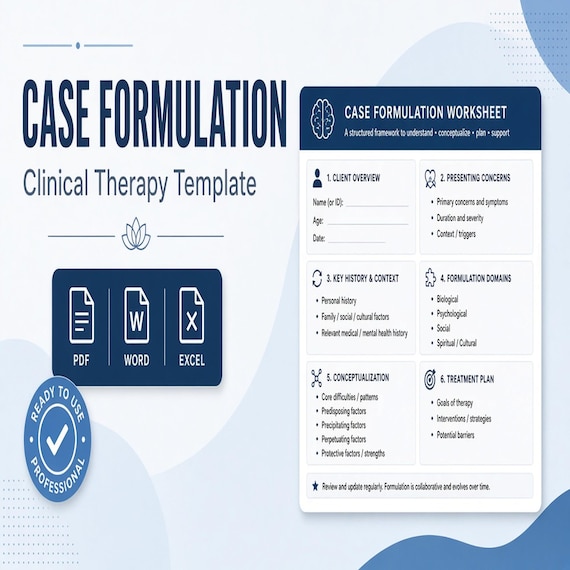
Case Formulation Template
Therapist Case Formulation & Conceptualization Toolkit Bring assessment details, working hypotheses, strengths, context…
Depression Workbook
Depression Workbook with CBT Behavioral Activation Worksheets, Depression Cycle, Mood Tracker, Activity Schedule Printable PDF.
Couples Therapy Worksheets
Couples Therapy Worksheets — a practical printable gift for a couples therapist, counselor, or a partner who wants structured…