
Therapist Forms & Notes · Aug 5, 2026 · 7 min read
4 Ps Case Formulation Template: How to Use It
Use a 4 Ps case formulation template (predisposing, precipitating, perpetuating, protective) to build and revise a working hypothesis, step by step.

4 Ps case formulation in 30 seconds
The 4 Ps case formulation sorts what you know about a client into four questions: why this person (predisposing), why now (precipitating), why it keeps going (perpetuating), and what helps (protective). You then link those factors in a short working hypothesis that you test and revise as the work goes on. A 4 Ps template is simply a page that keeps those four boxes, the hypothesis, and the evidence that would change it in one place.
- Predisposing: earlier factors that may have raised vulnerability
- Precipitating: recent changes or events linked to when the concern started or got worse
- Perpetuating: patterns and conditions that may be keeping it going
- Protective: strengths, supports and resources that may help change
- Working hypothesis: one to three sentences that connect the four, written as tentative
The 4 Ps explained, with a question for each box
Each P answers a different question. If you are not sure where a factor goes, ask which question it answers for this client right now.
A factor can sit in more than one box. A demanding job might be a precipitating change and also a perpetuating pressure. Put it where its current role is clearest and note the link, rather than copying it into every box.
- Predisposing, "Why was this person vulnerable?": temperament, family history, early experiences, learned beliefs, long-standing coping styles, community and economic conditions
- Precipitating, "Why now?": a loss, move, conflict, health change, job change, a break in support, or several small stressors landing together
- Perpetuating, "Why hasn't it settled?": avoidance, rumination, poor sleep, substance use, reassurance seeking, ongoing conflict, money or housing stress, responses from others that keep the cycle going
- Protective, "What is helping, and what can we build on?": supportive people, skills that have worked before, values, faith or culture, stable routines, motivation, access to care
4 Ps vs 5 Ps of case formulation
The 5 Ps model is the 4 Ps with one more box at the front: the presenting problem. Instead of a short intro sentence, the presenting concern becomes its own section, described in concrete terms and in the client's words, and every other factor has to help explain it.
Use the 5 Ps when the formulation must stand on its own, for example in a case presentation or a training assignment. Use the 4 Ps when the presenting picture is already written up elsewhere in the same record. If your program asks for a particular model, use theirs.
- 4 Ps: predisposing, precipitating, perpetuating, protective
- 5 Ps: presenting problem plus the same four
- Converting is easy: add a Presenting Patterns page in front of the 4 Ps page, or fold it into a one-line summary
A 4 Ps case formulation example (fictional)
This short example is made up for teaching. It shows the level of detail that fits on one page. Real cases need your own assessment, supervision and setting rules.
Case ID C-14, adult, outpatient. Presenting concern in the client's words: "I can't make myself go to work and I sleep all weekend." Formulation question: what is keeping the low mood and missed workdays going since the job change?
- Predisposing: says she has always been "the one who never lets anyone down"; a parent had long periods of low mood
- Precipitating: moved to a new team four months ago with a manager who gives feedback by email only; a close friend moved away the same month
- Perpetuating: calls in sick after a bad email, then spends the day in bed; rumination about being "found out"; weekend sleep pushes Monday bedtime later; has stopped seeing the climbing group
- Protective: sister checks in daily; enjoyed climbing and wants to go back; kept her last job through a hard year; came to sessions on her own
- Working hypothesis: high standards and a family model of withdrawal may make criticism feel like a threat. The new team and the friend's move removed feedback and support at the same time. Avoidance gives short-term relief but raises the next day's dread, and the loss of routine keeps mood low. Her sister, her wish to climb again and her past success at work are the best levers.
- What would revise this: if mood stays low on days with no work contact, or if sleep changes come first, the cycle above is not the whole story
How to fill in a 4 Ps template, step by step
Work in this order so the explanation comes after the facts, not before them.
- 1. Start a de-identified snapshot: a case ID instead of a name, a non-identifying age range and setting, the consultation question, presenting concerns in the client's words, strengths and current supports.
- 2. Write the client's priorities and language: what matters most to them, the goals and words they use, and what success would look like.
- 3. Describe patterns, not labels: when the concern shows up, its impact on daily roles, the exceptions, and the client's own view of it.
- 4. Fill the four boxes with only the factors that help answer your question. Leave out history that does not connect.
- 5. Write the working hypothesis in plain sentences using "may" and "because", then note what would make you revise it.
- 6. Test it: list the main and alternative hypotheses, what would support or disconfirm each, and a review date.
- 7. Link it to goals in the client's words and to the treatment plan, without turning the formulation into the plan itself.
- 8. Review on a schedule. Record what changed, the hypothesis and plan updates, open questions and the next review date.
When four boxes are not enough
The 4 Ps tells you when a factor did its work. Other views tell you what kind of factor it is or how a cycle runs.
- Biopsychosocial grid: put biological, psychological and social rows under the four columns. A biopsychosocial formulation like this helps you spot an empty corner, such as no social protective factors yet.
- Maintaining cycle: map thoughts, emotions, behaviors, body cues and how the environment responds, then mark break-point opportunities. This often makes the perpetuating box much clearer.
- Trigger, response, consequence: sketch a trigger, the immediate response, the short-term and longer-term consequence, and the function it may serve.
- Cultural context and systems: note relevant identities, cultural strengths, barriers and power, and the people and systems around the client. Context belongs inside the formulation, not in a final box.
Common mistakes
- Copying the whole intake history into predisposing. Keep only what connects to the question.
- Writing the hypothesis first and then sorting facts to fit it.
- A one-line protective box. Give strengths equal space and say how each one actually helps.
- Treating the formulation as final. Date it and set a review trigger.
- Using the template as a risk assessment. Follow your setting's risk and crisis procedures and use its approved tools.
The printable 4 Ps case formulation template
The SteadyStackStudio Therapist Case Formulation and Conceptualization Toolkit is a 25-page US Letter PDF for trained clinicians and supervised trainees, with an editable Word version of the pages and an Excel review tracker. Page 6 is the 4 Ps Formulation page, with boxes for each P, a working hypothesis and "What would revise this". Around it sit the pages used in the steps above (case snapshot, priorities, patterns, biopsychosocial and systems maps, cultural context, maintaining cycle, hypothesis builder, goal map, formulation review) plus a supervision summary, a one-page integrated summary and an optional share sheet for the client.
The Excel tracker has a Tracker tab for case ID, review date, hypothesis, goal, outcome marker, status (Draft, Active, Reviewed or Closed) and next review, with 100 entry rows. It flags reviews as Overdue or Due soon within 7 days, and a Dashboard counts reviews by status and month. It works in Excel and Google Sheets. It is a thinking and organizing resource, not a diagnostic tool, EHR or risk assessment, so store client details only where your setting allows.
See the 4 Ps case formulation template on Etsy, or browse all therapist forms and notes.
Related forms and guides
A formulation sits between assessment and planning. If you still need the intake side, the biopsychosocial assessment template is a fillable PDF and Word intake (cover plus 13 pages) with a strengths and clinical summary page (view it on Etsy). For the step after, the treatment plan template for therapists holds SMART goals, a problem, goal and intervention map, and progress reviews.
More from the same shelf: the therapy worksheets guide hub, the school counselor caseload tracker guide for referrals and follow-ups, and the motivational interviewing worksheet setup guide for planning OARS and change talk.
Frequently asked questions
What are the 4 Ps of case formulation?
Predisposing, precipitating, perpetuating and protective factors. Predisposing factors made the person more vulnerable, precipitating factors explain why the concern started or worsened now, perpetuating factors keep it going, and protective factors support coping and change. Together they feed a short, tentative working hypothesis that you review as you learn more.
What is the difference between the 4 Ps and the 5 Ps?
The 5 Ps adds the presenting problem as its own first section. The four explanatory boxes stay the same. The 5 Ps works well when the formulation has to stand alone, such as a case presentation, while the 4 Ps fits when the presenting concern is already documented elsewhere. Follow the model your program or supervisor uses.
What is an example of a perpetuating factor?
Anything that keeps the concern going after the trigger has passed. Common examples are avoidance that brings short-term relief, rumination, poor sleep, substance use, reassurance seeking, ongoing conflict, or money and housing stress. Write it as a cycle, such as missing work after a hard email, which raises dread the next day, so it can be tested.
Can a factor go in more than one of the 4 Ps?
Yes. A job, a relationship or a health issue can be both a trigger and a maintaining pressure, or both a stressor and a strength. Put it where its current role is clearest, note the other role, and come back to it at the next review. A formulation is a working hypothesis, so moving a factor later is normal.
How is a case formulation different from a treatment plan?
The formulation explains: it links factors into a tentative account of what is going on. The treatment plan acts: it records agreed goals, interventions, responsibilities and review dates. Use the formulation to choose and justify the plan, and keep the exact goal wording and schedule in the plan itself.
Is a 4 Ps template a diagnostic or risk assessment tool?
No. It is a page for organizing your clinical thinking. It does not diagnose, measure risk or replace training, supervision or your setting's documentation rules. Use your organization's approved risk and crisis procedures, and keep identifying details only in systems your employer or practice allows.
Printables used in this guide
Instant downloads from the SteadyStackStudio Etsy shop.
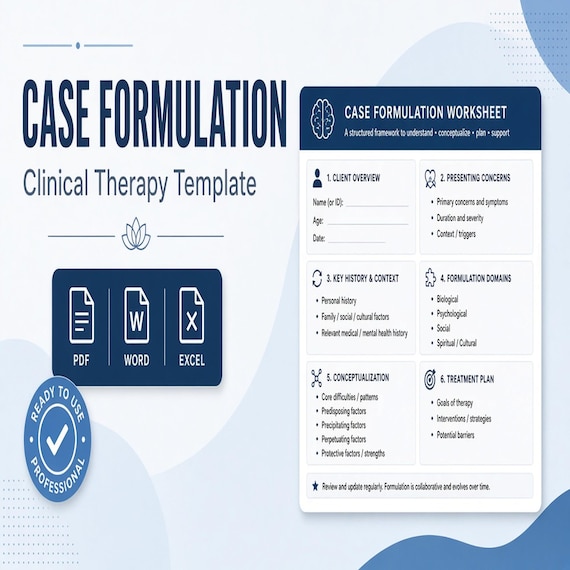
Case Formulation Template
Therapist Case Formulation & Conceptualization Toolkit Bring assessment details, working hypotheses, strengths, context…

Biopsychosocial Assessment Template
A complete biopsychosocial assessment template for intake sessions. Every area is laid out in order, so you cover the biological, psychological and social picture and finish with a clear summary and plan. For…

Treatment Plan Template for Therapists
A printable treatment planning kit for trained helpers who want clear goals, session agendas, and progress reviews — without…

Clinical Supervision Notes Template
A calm, practical download for clinical supervisors, supervisees, counselors, social workers, and training programs that need a…