Spanish Party Games · Jul 9, 2026 · 8 min read
How to Print and Host Spanish Bridal Shower Lotería Games
A practical host guide for printing Spanish or bilingual bridal shower lotería, preparing boards and markers, explaining the rules, and keeping the party moving.
Confirm what is in the download before you print
A bridal shower lotería game normally needs two different pieces: a caller deck and one playing board for each guest or team. The caller draws one card at a time and announces the picture or phrase. Players mark the matching picture when it appears on their board. Bridal versions adapt that familiar format with wedding, bride, couple, party, or gift images, so the exact card count and winning pattern may differ from a traditional set.
Open the files and separate the caller cards, player boards, instructions, signs, and any extra games before sending anything to the printer. Check whether the wording is Spanish-only or bilingual, whether the boards are all different, and whether the caller cards need to be cut apart. A cover page or listing thumbnail cannot answer those questions; the actual file list and preview pages should.
- Caller deck: the cards the host shuffles and announces.
- Player boards: one per guest or one per team, depending on the plan.
- Instructions: the included win patterns, setup notes, and any suggested markers.
- Extras: prize cards, signs, trivia, advice cards, or other despedida de soltera pages.
Choose the board count from the guest list
Count the guests who are likely to play, then print a few spare boards for late additions, misprints, spills, or anyone who changes seats. A simple cushion is one extra board for every ten expected players. For a shower with 28 players, printing 31 or 32 boards is more comfortable than stopping at exactly 28.
Do not assume that every printable contains unlimited unique boards. Some downloads are designed for a small table, while others include dozens of different boards for a larger party. Repeating a board is not automatically a problem, but two guests with the same board can mark the same images and win together. If the file includes fewer boards than the guest count, let pairs play as teams instead of quietly duplicating pages and creating avoidable ties.
- Small shower: give each guest a board and keep two or three spares.
- Large shower: confirm the number of different boards before checkout.
- Mixed ages: team play can make the game easier for children or guests who want help.
- Several rounds: guests can trade boards between rounds for a fresh pattern.
Run one test print before printing the full set
Print one caller page and one player board first. Use the paper size named in the download, then check the print dialog for scaling. “Actual size” or 100 percent is usually the safest starting point when trim lines and card dimensions matter. “Fit to page” can shrink cards, move margins, or make a front-and-back layout harder to align. If the download gives different instructions, follow those instead.
Read the smallest words from arm’s length, make sure dark backgrounds are not swallowing fine text, and confirm that the important parts sit inside the printable area. If the design uses a lot of color, compare normal and best-quality settings before committing to a large batch. Home printer ink can cost more than expected, so a local print shop may be the easier choice for a big guest list or heavy cardstock.
- Check letter size versus A4 before printing.
- Confirm portrait or landscape orientation.
- Print one board in color and one in grayscale if ink use matters.
- Cut the test caller card to make sure the trim marks and final size work.
Pick paper and markers that match the party setup
Player boards do not have to be printed on the heaviest paper. Standard paper works for a one-time game, especially when boards will sit flat on tables. Light cardstock feels sturdier and is easier to reuse for several rounds. The caller cards benefit most from cardstock because the host will shuffle, hold, and draw them repeatedly. If the design has a back page, confirm whether it is optional before attempting double-sided printing.
Markers should cover a picture without damaging the board. Dry beans, coins, buttons, candy pieces, reusable chips, or small paper circles can all work. Pens are faster to distribute but make boards single-use. For a seated shower, place markers in small bowls at each table. For a standing or moving party, give each player a small cup or envelope so pieces do not scatter.
- Plain paper: quickest and lowest-cost for a single round.
- Light cardstock: sturdier for caller cards and repeated play.
- Loose markers: reusable and easy to reset between rounds.
- Pens or pencils: simplest when each board will be used only once.
Set the winning pattern before the first card is called
Lotería can use several winning patterns, including a row, column, diagonal, four corners, or a full board. Choose one pattern before the round begins and show it visually if possible. A quick example board with the winning spaces highlighted is clearer than a long explanation while guests are talking, eating, or finding their seats.
Decide how ties will work too. You can give equal prizes, use one extra caller card as a tie-breaker, or ask tied players a simple bride-and-couple trivia question. Whatever you choose, say it before play begins. If the printed set includes its own rules, use them as the default so the pictures, board size, and intended pattern stay aligned. The host should also keep the drawn cards in a face-up pile so a claimed win can be checked without replaying the whole round.
- Fast round: one row, column, or diagonal.
- Medium round: four corners or a chosen picture pattern.
- Longer round: full board, if the deck and timing support it.
- Win check: compare the marked spaces against the caller’s drawn-card pile.
Use a short explanation for Spanish or bilingual guests
A mixed-language room does not need a long speech. Show one board, one caller card, and one marker while explaining the rules. Visual demonstration does most of the work. If the set is bilingual, decide whether the caller will read Spanish first, English first, or both each time. Keep that order consistent so guests know what to listen for.
A simple Spanish explanation is: “Cada persona recibe un tablero. Voy a sacar una tarjeta y decir el nombre. Marquen la imagen si aparece en su tablero. Gana la primera persona que complete una línea y diga: ¡Lotería!” Change “una línea” to “las cuatro esquinas” or “todo el tablero” if that is the chosen pattern. For a bilingual room, repeat the same directions briefly in English and let players ask questions before the first card is drawn.
- Hold up the caller card so guests can see the image as well as hear the word.
- Use the same Spanish-English calling order throughout the round.
- Repeat a card once before moving on if the room is noisy.
- Avoid turning the game into a language test; the goal is easy group participation.
Build a simple 30-minute game flow
One strong game is often better than scheduling every printable in a bundle. Set aside a clear window after guests have arrived but before gift opening or a meal transition. Five minutes is enough to hand out boards, explain the pattern, and answer questions. A first round can run for about ten minutes, followed by a quick prize and reset. If the room is enjoying it, run a second round with a different winning pattern or let guests exchange boards.
Keep the caller deck, spare boards, markers, prizes, scissors, and tape in one host basket. That prevents the game from stalling while someone searches another room. Ask one helper to distribute boards and check a winning claim while the caller keeps the group’s attention. If the party is running late, shorten the game to one-row lotería rather than rushing through several unrelated activities.
- Minutes 0–5: distribute boards and markers; explain the rule and prize.
- Minutes 5–15: play the first round and check the winner.
- Minutes 15–25: optional second round with exchanged boards or a new pattern.
- Minutes 25–30: collect reusable markers and move into the next party activity.
Check the previews and file details before opening Etsy
Before choosing a Spanish bridal shower game, compare the part that affects hosting: how many boards are included, whether a caller deck is provided, which languages appear, what paper size is used, and how much cutting is required. A large bundle can be useful when you need several table activities, signs, and games, but it can also create extra printing work. Choose the smallest complete download that covers the actual party plan.
For a lotería-centered shower, the best preview shows the caller cards, several different player boards, the instruction page, and the finished printed scale. For a broader despedida de soltera bundle, look for a clear list of the other games and decide when each one would be used. Confirm whether the files are PDFs, JPG pages, or editable templates. An instant download should still explain what the host receives after checkout.
- Guest fit: enough boards for the expected players or teams.
- Language fit: Spanish-first, English-first, or bilingual wording that suits the room.
- Printer fit: letter or A4 size, color use, margins, and cutting requirements.
- Party fit: one focused lotería game or a larger matching activity bundle.
- Preview fit: actual boards and caller cards, not only a styled cover image.
Use this event-day checklist
The night before the shower, count the boards, shuffle the caller cards, separate the prizes, and place everything in the host basket. Keep one uncut digital file available on a phone or laptop in case a page needs to be reprinted. Label the caller deck so it does not get mixed with trivia cards or other bundle pages. If the event has assigned tables, place the right number of boards and marker bowls at each table before guests arrive.
On the day, explain one pattern, call at a steady pace, show each picture, and leave a short pause for guests to mark their boards. Keep the atmosphere relaxed. The printable is there to make hosting easier, help relatives and friends join the same activity, and give the bride a fun shared moment—not to fill every minute of the celebration.
- Printed boards plus a few spares.
- Cut and shuffled caller deck.
- Markers, pens, or pencils in easy-to-reach containers.
- One or two prizes and a clear tie plan.
- A helper who can distribute pages and verify the winner.
- The matching product page saved if you need to recheck the file list or print format.
Printables used in this guide
Instant downloads from the SteadyStackStudio Etsy shop.
Despedida de Soltera Games Bundle
Juegos de despedida de soltera — paquete imprimible en español (con apoyo bilingüe): Lotería bridal party con 8 tablas únicas, 54…
Bridal Shower Loteria Game
Bridal Shower Lotería games — Spanish-inspired bridal shower & bachelorette printable bundle: 8 unique boards, 54 caller cards…
Loteria Para Novia Printable
A Spanish bridal shower printable bundle with lotería para novia, despedida de soltera games and quick party pages for a…
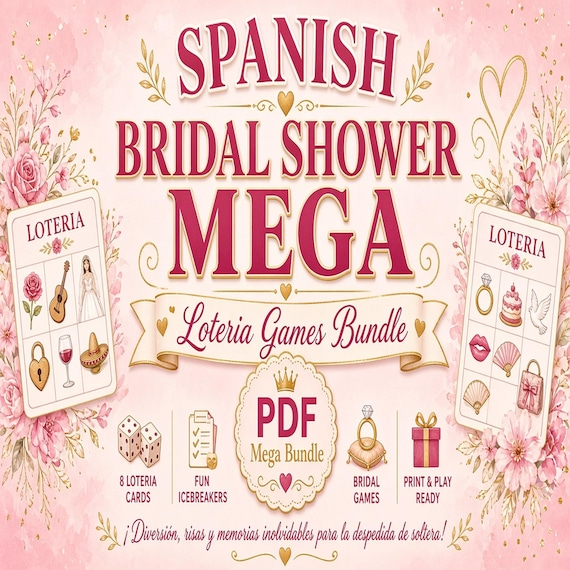
Spanish Bridal Shower Games Mega Bundle
A Spanish bridal shower games mega bundle with lotería, party printables, signs and activity pages for a simple instant-download…